What Is This Strange Vintage Kitchen Tool? The Forgotten Purpose Revealed
Before modern kitchen equipment and convenient carving systems, preparing a large roast at the dinner table could be surprisingly awkward.
A large leg of mutton or lamb is:
Heavy
Hot
Difficult to hold
Often covered with juices
Difficult to stabilize with an ordinary fork
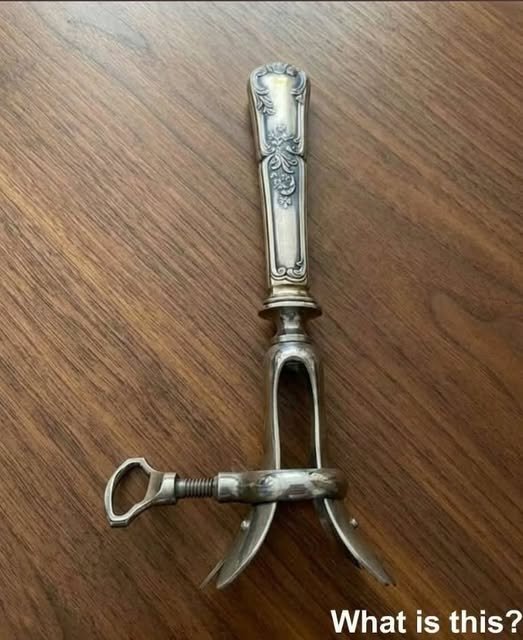
A traditional carving fork could help, but a dedicated leg-of-mutton holder provided a much firmer grip.
The cook could secure the meat and then carve slices without having to hold the hot roast directly.
🏛️ A Sign of an Old-Fashioned Formal Dinner
These tools weren’t simply practical kitchen gadgets.
Some were beautifully made and featured elaborate silver or silver-plated handles.
Historical examples include ornate French and English versions, including pieces associated with makers such as Christofle and other silversmiths. (Etsy)
In the 19th and early 20th centuries, specialized serving and carving accessories could also be part of an elegant dining service.
One documented example even describes a silver leg-of-mutton holder with a decorated handle dating to around the early 1900s. (faglon.com)
So the strange object in your grandmother’s collection may actually be a little piece of culinary history.
🔩 What Is the Screw For?
This is probably the most confusing part when looking at the tool for the first time.
The small screw isn’t decorative.
It controls the gripping mechanism.
By turning the screw, the jaws can be opened or tightened around the shank of the roast.
That allowed the holder to accommodate the meat securely.
A historical description of this type of tool specifically explains that the screw was used to open the holder and then latch it onto the leg of mutton. (Subsaga)
🍽️ How It Was Used at the Dinner Table
Imagine a traditional Sunday or holiday roast.
A large leg of lamb or mutton would be brought to the table.
Instead of trying to hold the hot joint with a regular fork, the cook would:
Open the holder using the screw.
Position the gripping end around the shank of the roast.
Tighten the mechanism securely.
Lift the meat using the decorated handle.
Carve slices with a carving knife.
Serve the meat while keeping the roast stable.
It was essentially an old-fashioned handle for controlling a large roast while carving.
🤔 Why Does It Look So Strange Today?
Because this is a type of kitchen equipment that has largely disappeared from everyday cooking.
Modern cooks usually use:
Carving forks
Tongs
Roasting racks
Cutting boards with meat grips
Modern carving tools
Few people today prepare and carve a whole leg of mutton at the table in the traditional way.
That’s why an old leg-of-mutton holder can look almost completely mysterious to someone who has never encountered one.
🥩 Mutton vs. Lamb
You might be wondering why it’s called a leg-of-mutton holder rather than simply a lamb holder.
Traditionally, mutton refers to meat from an adult sheep, while lamb comes from a younger sheep.
The tool itself could be useful for holding similar large joints regardless of the exact age of the animal.
Historical descriptions commonly call the device a “leg of mutton holder” or “shank holder.” (Subsaga)
🕰️ A Forgotten Piece of Kitchen History
What’s fascinating about objects like this is that they show how much cooking and dining have changed.
Today, many of us would simply use a fork and carving board.
But generations ago, specialized tools were created for almost every stage of preparing and serving a formal meal.
A beautifully decorated tool like this wasn’t necessarily something hidden away in a drawer for no reason.
It may have once been brought out for Sunday roasts, holiday dinners, weddings, or other formal meals.
🔍 Could Yours Be Valuable?
Possibly—but the value depends on several factors.
Look closely for:
Maker’s marks
Silver hallmarks
Engravings
A manufacturer’s name
Country of origin
Sterling or silver-plated markings
The condition of the handle
Whether the gripping mechanism still works
Some antique silver examples can have collectible value, particularly when they were made by well-known silversmiths or have desirable hallmarks. For example, documented antique and vintage leg-of-mutton holders include French silver and silver-plated examples from the early 20th century. (Etsy)
Don’t polish an antique aggressively before identifying it. Original patina and surface condition can sometimes be important to collectors.
🧠 Final Answer
So, what is that mysterious object?
It’s a vintage leg-of-mutton holder (shank holder), a specialized tool used to grip and lift a leg of lamb or mutton while carving.
The screw tightened the gripping jaws around the meat, while the long handle gave the cook a secure way to hold the roast.
What looks like a strange metal contraption today was once a practical—and sometimes very elegant—piece of dining equipment. (Subsaga)
👇 Did You Guess It?
If you saw this object without knowing its purpose, what would you have guessed it was?
A nutcracker? A cooking tool? A medical instrument? Something completely different?
Tell us your guess in the comments! 👇
And if you have an old kitchen tool in your family’s drawers that nobody can identify, share a photo—we might be able to figure it out.
To provide the best experiences, we use technologies like cookies to store and/or access device information. Consenting to these technologies will allow us to process data such as browsing behavior or unique IDs on this site. Not consenting or withdrawing consent, may adversely affect certain features and functions.
Functional
Always active
The technical storage or access is strictly necessary for the legitimate purpose of enabling the use of a specific service explicitly requested by the subscriber or user, or for the sole purpose of carrying out the transmission of a communication over an electronic communications network.
Preferences
The technical storage or access is necessary for the legitimate purpose of storing preferences that are not requested by the subscriber or user.
Statistics
The technical storage or access that is used exclusively for statistical purposes.The technical storage or access that is used exclusively for anonymous statistical purposes. Without a subpoena, voluntary compliance on the part of your Internet Service Provider, or additional records from a third party, information stored or retrieved for this purpose alone cannot usually be used to identify you.
Marketing
The technical storage or access is required to create user profiles to send advertising, or to track the user on a website or across several websites for similar marketing purposes.