This Mysterious Steel Tool Has a Surprisingly Specific Purpose
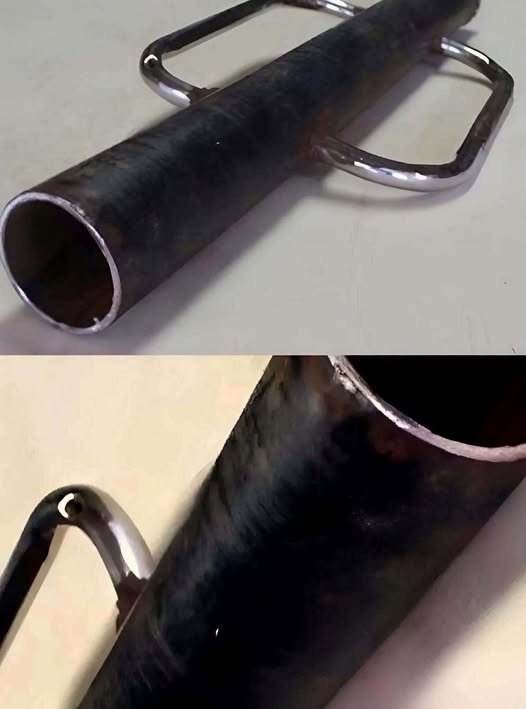
At first glance, this small steel tube with two side handles looks like a piece of scrap metal or part of a larger machine. But the design gives us an important clue: a hollow steel cylinder combined with two sturdy handles is typically meant to be pushed, pulled, or positioned with both hands.
The exact identity of the object in the photograph can’t be confirmed with certainty from the image alone, but its construction is consistent with a hand-operated coring or sampling tool.
🔧 What Is a Hand Corer?
A hand corer is a simple cylindrical tool used to remove a small, relatively undisturbed sample of material.
Depending on the type, it can be used for:
🌱 Soil sampling
🪨 Sediment sampling
🌊 Environmental research
🔬 Scientific fieldwork
🌾 Agricultural investigations
A documented hand corer design consists of a section of metal tubing with two handles, allowing the user to push the tube into soft sediment and then pull it back out with the sample inside. (NMBAQC)
🕳️ How Does It Work?
The principle is surprisingly simple.
Step 1: Position the Tube
The open end is placed against the soil, sand, mud, or other material being sampled.
Step 2: Push It Down
The user grips the two handles and pushes the cylindrical tube into the material.
The hollow interior allows a column of material to enter the tube.
Step 3: Pull It Out
Once the desired depth is reached, the tool is rotated or rocked slightly and pulled upward.
The material inside the tube comes out as a relatively intact core sample.
Step 4: Remove the Sample
A plunger can then be used to push the sample out of the tube for examination.
This type of equipment is used in environmental and biological field studies to collect sediment samples. (NMBAQC)
🌱 Why Would Someone Need a Sample Like This?
Scientists and environmental workers sometimes need to know what’s happening beneath the surface.
A core can reveal:
Different soil layers
Sediment composition
Organic material
Small organisms
Moisture conditions
Changes in soil over depth
Instead of digging up a large area, a coring tool can remove a relatively small cylindrical sample.
🔍 The Handles Are the Big Clue
The two metal handles aren’t decorative.
They provide leverage so the user can apply downward force when inserting the tube and then pull and rotate it when removing the sample.
Similar hand corers are specifically described as cylindrical stainless-steel tubing fitted with two handles. (NMBAQC)
🤔 Could It Be Something Else?
Yes.
Because the photograph doesn’t show the complete tool or any markings, it’s not possible to identify it with 100% certainty.
There are other tools made from hollow steel tubing with handles, including various construction and sampling devices.
For example, heavy-duty steel tube tools with two handles are also manufactured for driving fence posts, although those are generally considerably longer and designed to slide over a post. (fencee – energizers for electric fencing)
So the object’s size, diameter, markings, and what the opposite end looks like would be important for a definitive identification.
🧠 The Interesting Part
What looks like a simple piece of hollow steel can actually be a specialized tool designed around one very basic idea:
Push a tube into material → capture a sample → pull it back out.
That’s why the open cylindrical end and two handles are such useful clues.
Final Thoughts
The object appears to be a hand-operated cylindrical sampling/coring tool or a similar field tool, rather than an ordinary household item.
The exact identification can’t be guaranteed from this single photograph, but the two-handle tube design closely resembles documented hand corers used to collect soil and sediment samples. (NMBAQC)
Would you have guessed what it was? 👀🔧
Do you think it’s a sampling tool, or do you have another idea? Tell us in the comments! 👇
To provide the best experiences, we use technologies like cookies to store and/or access device information. Consenting to these technologies will allow us to process data such as browsing behavior or unique IDs on this site. Not consenting or withdrawing consent, may adversely affect certain features and functions.
Functional
Always active
The technical storage or access is strictly necessary for the legitimate purpose of enabling the use of a specific service explicitly requested by the subscriber or user, or for the sole purpose of carrying out the transmission of a communication over an electronic communications network.
Preferences
The technical storage or access is necessary for the legitimate purpose of storing preferences that are not requested by the subscriber or user.
Statistics
The technical storage or access that is used exclusively for statistical purposes.The technical storage or access that is used exclusively for anonymous statistical purposes. Without a subpoena, voluntary compliance on the part of your Internet Service Provider, or additional records from a third party, information stored or retrieved for this purpose alone cannot usually be used to identify you.
Marketing
The technical storage or access is required to create user profiles to send advertising, or to track the user on a website or across several websites for similar marketing purposes.