Kitchen Utensils You Should Replace: When Old Tools Become a Food-Safety Problem
Your kitchen utensils may look perfectly fine at first glance, but some items can become difficult to clean after years of use. Cracks, deep grooves, chips, splinters, and damaged surfaces can trap food residue and make proper cleaning more difficult.
That doesn’t mean you need to throw away every old utensil in your kitchen. The important thing is to inspect each item and replace anything that is excessively worn or damaged.
Why Damaged Kitchen Tools Can Be a Problem
Food-contact surfaces should be smooth, intact, and easy to clean. The FDA Food Code states that food-contact surfaces should be free of cracks, chips, pits, crevices, and similar imperfections. (U.S. Food and Drug Administration)
Damaged surfaces can create places where food particles and microorganisms may remain even after washing.
The FDA has also specifically warned about damaged wooden utensils with splinters, chips, and residue trapped in cracks, noting that replacement with a cleanable, non-porous material may be appropriate. (U.S. Food and Drug Administration)
1. Old Cutting Boards
Cutting boards are among the kitchen items that deserve regular inspection.
If a board has become deeply scratched, cracked, warped, or excessively worn, replacing it is a good idea. The FDA notes that bacteria can grow in grooves and cracks that are difficult to clean. (U.S. Food and Drug Administration)
This applies to both wooden and plastic cutting boards.
Replace a cutting board if:
It has deep knife grooves.
It is cracked.
Pieces are breaking off.
It has become heavily warped.
You cannot properly clean its damaged areas.
2. Cracked Wooden Utensils
Wooden spoons, spatulas, and other wooden tools can last a long time when properly maintained.
However, once a wooden utensil develops deep cracks, splinters, chips, or rough damaged areas, it may become difficult to clean properly.
The solution isn’t to throw away every wooden utensil. Instead, inspect them regularly and replace damaged pieces.
3. Damaged Plastic Utensils
Plastic tools can also become worn.
Look for:
Deep scratches
Cracks
Melted sections
Missing pieces
Rough edges
Permanent discoloration associated with damage
If the utensil can no longer be adequately cleaned, replace it.
4. Scratched Nonstick Cookware
Nonstick cookware should also be inspected regularly.
If the coating is severely damaged, peeling, or flaking, replacing the cookware is generally preferable to continuing to use it.
Always follow the manufacturer’s instructions regarding cookware care and replacement.
5. Old Kitchen Sponges
Sponges can become contaminated with food particles and moisture.
Instead of keeping one sponge indefinitely, replace it regularly and keep kitchen cleaning materials separate from utensils used directly with food.
6. Cracked Containers
Plastic or glass food-storage containers with cracks, broken edges, or damaged lids can become difficult to clean properly.
Check containers regularly and replace damaged ones.
A container that no longer seals correctly may also allow food to dry out or become contaminated.
What About Stainless-Steel Utensils?
Stainless steel is generally durable and easy to clean, but it should still be inspected.
Replace or repair utensils with:
Sharp broken edges
Cracks
Loose handles
Severe corrosion
Damaged surfaces that cannot be properly cleaned
The goal is not simply to choose a particular material. The utensil needs to remain cleanable and in good condition.
How to Keep Kitchen Utensils Safer
The FDA recommends washing cutting boards, dishes, utensils, and countertops with hot, soapy water after preparing food. (U.S. Food and Drug Administration)
A few simple habits can make a big difference:
Wash utensils after use
Don’t allow food residue to remain on utensils for long periods.
Inspect them regularly
Every few weeks, look for cracks, chips, deep scratches, or other damage.
Separate raw-food equipment
Use appropriate cutting boards and utensils for raw meat and other foods, and clean them thoroughly after use.
Replace excessively worn items
If an item can no longer be adequately cleaned, replacing it is safer than trying to keep using it.
Should You Throw Away Everything in the Drawer?
No.
The viral phrase “throw it away if you have it in your kitchen” is too broad.
A kitchen utensil isn’t automatically dangerous simply because it is old. What matters is its condition, cleanliness, material, and ability to be properly cleaned and maintained.
A well-maintained wooden spoon can be perfectly usable, while a relatively new utensil with deep cracks or chips may need to be replaced.
A Simple Kitchen Check
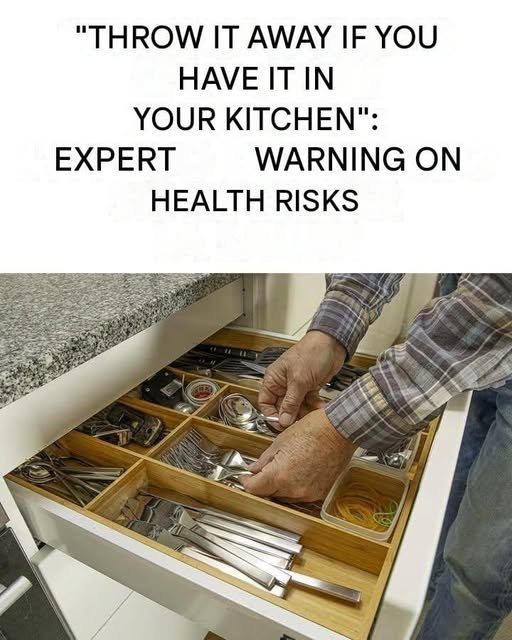
Open your kitchen drawer today and inspect your utensils.
Ask yourself:
Is it cracked? Is it chipped? Does it have deep grooves? Is it splintering? Can I clean it thoroughly? Is the handle loose or broken?
If the answer indicates that the item can no longer be properly cleaned or safely used, it’s time for a replacement.
Final Thoughts
You don’t need to panic about old kitchen utensils, but damaged food-contact tools shouldn’t be ignored.
Regular cleaning, proper storage, and replacing excessively worn or damaged utensils can help reduce the risk of food contamination. The FDA specifically recommends replacing excessively worn cutting boards because bacteria can grow in difficult-to-clean cracks and grooves. (U.S. Food and Drug Administration)
So before throwing everything away, inspect your kitchen tools carefully and replace the ones that are cracked, chipped, splintered, or no longer easy to clean.
How old is the oldest kitchen utensil you still use? 👇
To provide the best experiences, we use technologies like cookies to store and/or access device information. Consenting to these technologies will allow us to process data such as browsing behavior or unique IDs on this site. Not consenting or withdrawing consent, may adversely affect certain features and functions.
Functional
Always active
The technical storage or access is strictly necessary for the legitimate purpose of enabling the use of a specific service explicitly requested by the subscriber or user, or for the sole purpose of carrying out the transmission of a communication over an electronic communications network.
Preferences
The technical storage or access is necessary for the legitimate purpose of storing preferences that are not requested by the subscriber or user.
Statistics
The technical storage or access that is used exclusively for statistical purposes.The technical storage or access that is used exclusively for anonymous statistical purposes. Without a subpoena, voluntary compliance on the part of your Internet Service Provider, or additional records from a third party, information stored or retrieved for this purpose alone cannot usually be used to identify you.
Marketing
The technical storage or access is required to create user profiles to send advertising, or to track the user on a website or across several websites for similar marketing purposes.