I Came Home Exhausted, Then Noticed Something Strange Under My Bed
I came home exhausted, expecting nothing more than a quiet night and a good night’s sleep.
But when I walked into the bedroom, one small detail immediately caught my attention.
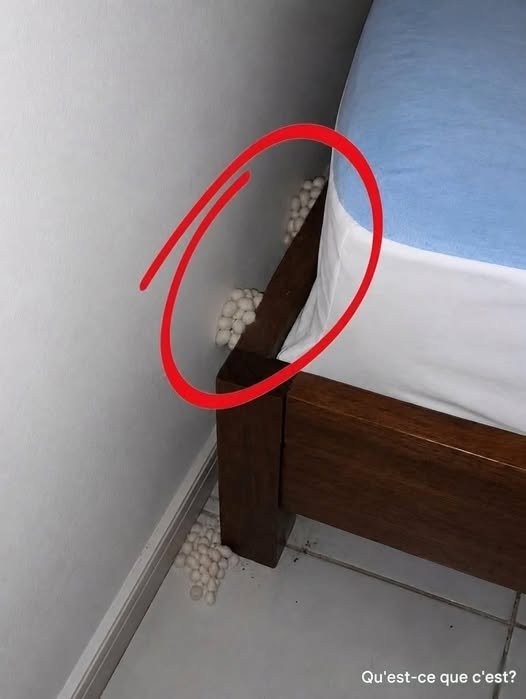
There were clusters of tiny white particles along the wooden bed frame and on the floor underneath it.
At first, they looked like bits of foam, grains of salt, or something that had simply fallen from the ceiling. But the location made me stop and take a closer look.
Could they be insect eggs? Pest debris? Or something completely harmless?
The truth is that white material around a bed frame should not automatically be identified as bed bug eggs from a photograph alone. However, because the material is close to a sleeping area, it’s worth knowing what to look for.
🔎 What Could Those White Specks Be?
One possibility people often think of when they see small pale objects around a bed is bed bug eggs.
Bed bug eggs are extremely small—around 1 millimeter—and are usually pearly white, oval or slightly elongated. They are typically attached to rough surfaces with a sticky substance and can be found in cracks, crevices, mattress seams, furniture joints, and other areas close to where people sleep. (CALS)
But there is an important detail:
The objects in this photograph appear larger and more numerous than typical individual bed bug eggs.
That means it would be irresponsible to look at this image and confidently say, “Those are definitely bed bug eggs.”
Several other possibilities exist.
🛏️ Why the Location Matters
The area around a bed provides many hiding places for household pests.
Bed bugs, for example, can hide in:
Mattress seams
Bed-frame joints
Screw holes
Cracks in wooden furniture
Headboards
Baseboards
Gaps around furniture
Female bed bugs lay tiny white eggs on rough surfaces near their hosts, and the eggs can remain attached to the surface after they hatch. (IPM Initiative)
So if you discover suspicious material around your bed, don’t just inspect the material itself.
To provide the best experiences, we use technologies like cookies to store and/or access device information. Consenting to these technologies will allow us to process data such as browsing behavior or unique IDs on this site. Not consenting or withdrawing consent, may adversely affect certain features and functions.
Functional
Always active
The technical storage or access is strictly necessary for the legitimate purpose of enabling the use of a specific service explicitly requested by the subscriber or user, or for the sole purpose of carrying out the transmission of a communication over an electronic communications network.
Preferences
The technical storage or access is necessary for the legitimate purpose of storing preferences that are not requested by the subscriber or user.
Statistics
The technical storage or access that is used exclusively for statistical purposes.The technical storage or access that is used exclusively for anonymous statistical purposes. Without a subpoena, voluntary compliance on the part of your Internet Service Provider, or additional records from a third party, information stored or retrieved for this purpose alone cannot usually be used to identify you.
Marketing
The technical storage or access is required to create user profiles to send advertising, or to track the user on a website or across several websites for similar marketing purposes.