Is Your Electrical Outlet Installed Upside Down? The Real Reason Behind the Different Orientations
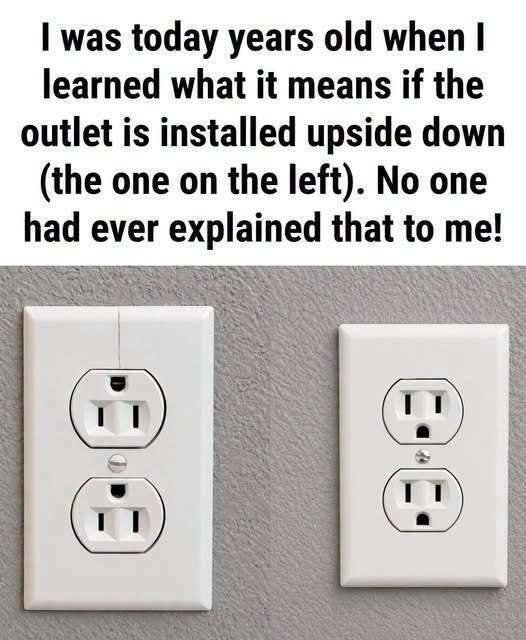
Have you ever looked at an electrical outlet and noticed that some are installed with the grounding hole on top, while others have it on the bottom?
If you’ve always assumed that one of them must be installed incorrectly, you’re not alone.
The truth is a little more interesting: in the United States, the National Electrical Code (NEC) does not generally require a standard wall receptacle to have the ground opening facing either up or down. The orientation can depend on local practice, the type of plug being used, and the installation itself. (NEMA Wiring Devices)
So why do electricians sometimes install outlets upside down?
🔌 What Does “Upside Down” Actually Mean?
A standard North American outlet has three openings:
Two vertical slots for the electrical conductors
One rounded opening for the equipment grounding connection
When the grounding opening is above the two slots, people often call it “ground-up.”
When it is below, it’s called “ground-down.”
Both orientations can be found in real homes and commercial buildings.
🟢 Is Ground-Up Actually Safer?
There is a practical argument for installing the ground opening on top.
Imagine a plug that is partially pulled out of the receptacle. If a conductive metal object were to fall behind the plug, having the grounding connection at the top could potentially reduce the chance of the object contacting an energized blade first.
This is one reason some electricians and engineers prefer the ground-up orientation, particularly in certain commercial or industrial installations.
However, this should not be presented as a universal safety requirement. The NEC does not prescribe a particular up/down orientation for ordinary receptacles. (EC&M)
⚡ Why Do Some Outlets Have the Ground on the Bottom?
There is nothing inherently wrong with the ground being at the bottom.
In many residential installations, electricians simply follow the orientation already used throughout the building.
Consistency can actually be useful.
If every receptacle in a home has the same orientation, it’s easier to recognize unusual installations and gives the electrical system a uniform appearance.
NEMA’s wiring-device guidance specifically notes that functionality should drive orientation, and that local convention and consistency can also matter. (NEMA Wiring Devices)
🏠 Your Plug May Determine the Best Orientation
This is something many people don’t realize.
Some appliances use plugs where the cord exits straight down.
Others have right-angle plugs, where the cord leaves the plug horizontally before turning toward the floor.
Depending on the appliance and the available space, one receptacle orientation may allow the cord to sit more naturally.
NEMA notes that the type of cord set can influence the preferred orientation, particularly when the cord immediately makes a 90-degree turn. (NEMA Wiring Devices)
To provide the best experiences, we use technologies like cookies to store and/or access device information. Consenting to these technologies will allow us to process data such as browsing behavior or unique IDs on this site. Not consenting or withdrawing consent, may adversely affect certain features and functions.
Functional
Always active
The technical storage or access is strictly necessary for the legitimate purpose of enabling the use of a specific service explicitly requested by the subscriber or user, or for the sole purpose of carrying out the transmission of a communication over an electronic communications network.
Preferences
The technical storage or access is necessary for the legitimate purpose of storing preferences that are not requested by the subscriber or user.
Statistics
The technical storage or access that is used exclusively for statistical purposes.The technical storage or access that is used exclusively for anonymous statistical purposes. Without a subpoena, voluntary compliance on the part of your Internet Service Provider, or additional records from a third party, information stored or retrieved for this purpose alone cannot usually be used to identify you.
Marketing
The technical storage or access is required to create user profiles to send advertising, or to track the user on a website or across several websites for similar marketing purposes.