I Found This Strange Thing on My Bedroom Floor — What Is It?
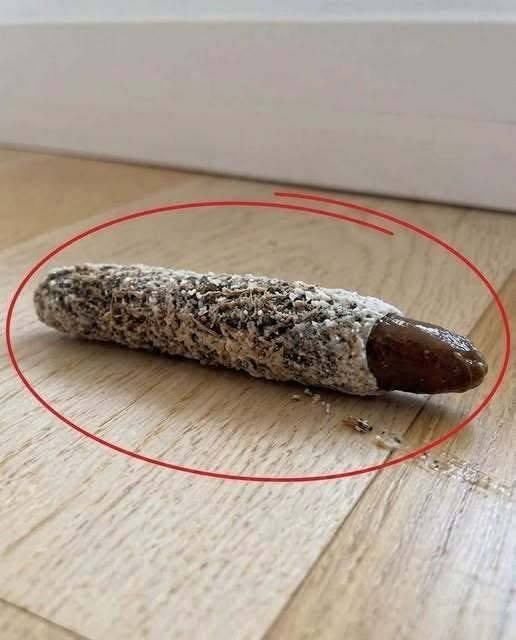
At first glance, this strange little object can look like a piece of dirt, a dried caterpillar, or even something much more alarming.
But if you find something similar slowly moving across a floor or wall, there is a good chance you’re looking at the protective case of a case-bearing moth larva, sometimes called a household casebearer or plaster bagworm.
The exact species can’t be confirmed from this photograph alone, but the shape and appearance are consistent with the cases made by small moth larvae. These larvae create portable cases from silk mixed with fibers, dust, hair, and other debris from their surroundings. (Ask IFAS – Powered by EDIS)
🐛 What Is That Brown Part?
The dark brown section visible at one end is likely the head of the larva.
The larva lives inside the elongated case and can extend its head and legs from the opening to move around. When disturbed, it can retreat back inside for protection. (Ask IFAS – Powered by EDIS)
This is why these little objects can look so strange: you’re essentially seeing a tiny caterpillar wearing a portable protective case.
🧵 What Is the White, Fuzzy Material?
The case isn’t simply a cocoon.
Case-bearing moth larvae construct their cases using silk combined with environmental materials, which can include fibers, dust, hair, insect debris, and other small particles.
This can give the case a rough, fuzzy or dirty appearance. (Veseris)
Some species create flattened or elongated cases that can be several millimeters long. Household casebearer larvae, for example, can produce cases roughly 8–14 mm long. (Ask IFAS – Powered by EDIS)
🏠 Why Would You Find One Near a Bedroom?
Case-bearing moth larvae prefer protected areas where they can find suitable organic material.
Depending on the species, related clothes-moth larvae can feed on materials such as:
Wool
Fur
Hair
Feathers
Felt
Other animal-derived fibers
They may also hide in cracks, along carpet edges, underneath furniture, or in other undisturbed areas. (Yard and Garden)
So finding one doesn’t necessarily mean you have a major infestation.
🔎 Should You Be Worried?
Usually, there’s no reason to panic.
These larvae are not dangerous to people and aren’t something that should cause you to worry about being bitten or attacked.
The main reason to pay attention is if you start finding many cases or larvae around the house.
Repeated sightings could indicate that there is a suitable food source or hiding place nearby.
🧹 What Should You Do If You Find One?
If you only found one, the simplest solution is to remove it and clean the surrounding area.
Try:
1. Vacuum Carefully
Vacuum along:
Carpet edges
Under furniture
Baseboards
Bedroom corners
Closets
Areas where dust accumulates
2. Check Your Closet
Look at woolen clothing, blankets, rugs, and other natural-fiber materials for signs of damage.
Case-bearing clothes moth larvae can create protective cases while feeding on animal-based fibers. (Yard and Garden)
3. Reduce Dust and Hair
Regular vacuuming and cleaning can remove the materials these larvae may use to construct their cases.
4. Look for More Cases
Check dark, quiet places where they may be hiding.
If you discover numerous cases, inspect stored fabrics and carpets more carefully.
❌ Don’t Assume It’s a Dangerous Worm
The unusual appearance can make these little creatures look much worse than they actually are.
The brown “tail” or head sticking out of the case can make it look almost like something from a horror movie—but it’s simply part of the larva moving around inside its protective case.
🐛 Is It a Cocoon?
Not exactly.
A cocoon is generally a protective structure associated with the pupal stage.
A case-bearing moth larva, on the other hand, can carry its case around while it is still a feeding and growing larva. University extension sources describe these cases as portable structures that protect the larva while it moves around. (Ask IFAS – Powered by EDIS)
That’s one of the most interesting things about these tiny insects.
Final Thoughts
That strange object on your bedroom floor is most likely a case made by a small case-bearing moth larva, such as a household casebearer or plaster bagworm, although the exact species cannot be confirmed from the photo alone.
The rough, debris-covered tube and the dark portion protruding from one end are consistent with the way these larvae live and move around inside their protective cases. (Ask IFAS – Powered by EDIS)
If you find just one, simply remove it and clean the area. If you begin finding many, inspect closets, carpets, rugs, and stored natural-fiber materials for a possible source.
Have you ever found one of these strange little “cases” in your home? 🐛👀 What did you think it was at first? Tell us in the comments!
To provide the best experiences, we use technologies like cookies to store and/or access device information. Consenting to these technologies will allow us to process data such as browsing behavior or unique IDs on this site. Not consenting or withdrawing consent, may adversely affect certain features and functions.
Functional
Always active
The technical storage or access is strictly necessary for the legitimate purpose of enabling the use of a specific service explicitly requested by the subscriber or user, or for the sole purpose of carrying out the transmission of a communication over an electronic communications network.
Preferences
The technical storage or access is necessary for the legitimate purpose of storing preferences that are not requested by the subscriber or user.
Statistics
The technical storage or access that is used exclusively for statistical purposes.The technical storage or access that is used exclusively for anonymous statistical purposes. Without a subpoena, voluntary compliance on the part of your Internet Service Provider, or additional records from a third party, information stored or retrieved for this purpose alone cannot usually be used to identify you.
Marketing
The technical storage or access is required to create user profiles to send advertising, or to track the user on a website or across several websites for similar marketing purposes.