What Is This Strange Solid-Metal Tool With a Tiny Scoop?
The tiny scoop is actually the most important clue.
Unlike a normal spoon, an ear spoon wasn’t designed to hold a large quantity of anything.
Its small bowl-shaped end was intended for very delicate, precise grooming.
Historical museum collections specifically classify these objects as equipment related to grooming, hygiene, and health care.
The long handle allowed the user to hold the tool while keeping the tiny scoop at the end.
🏺 How Old Are Ear Spoons?
Much older than you might expect.
The Science Museum Group has an ancient bronze ear spoon dating to approximately 100–400 BCE, while another Roman example in its collection is dated to around 199–500 CE.
The Metropolitan Museum also has an ancient Sasanian example dating from roughly the 3rd to 7th century CE.
So when someone sees one of these and says, “I’ve never seen anything like it,” that’s completely understandable.
Modern hygiene products have largely replaced these traditional implements.
🧼 How Were They Used?
Historically, the small spoon-shaped end could be used to gently remove accumulated earwax from the outer part of the ear.
Similar objects were sometimes incorporated into multi-purpose grooming sets.
For example, the Metropolitan Museum has a British silver object from 1874–75 identified as an “ear spoon and tweezer.”
Another historical example combines an ear spoon with a pointed tool, demonstrating how personal grooming implements could serve multiple purposes.
✨ Some Were Surprisingly Decorative
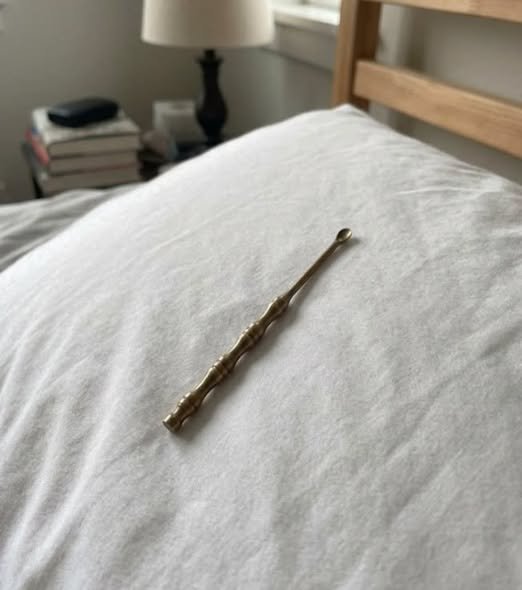
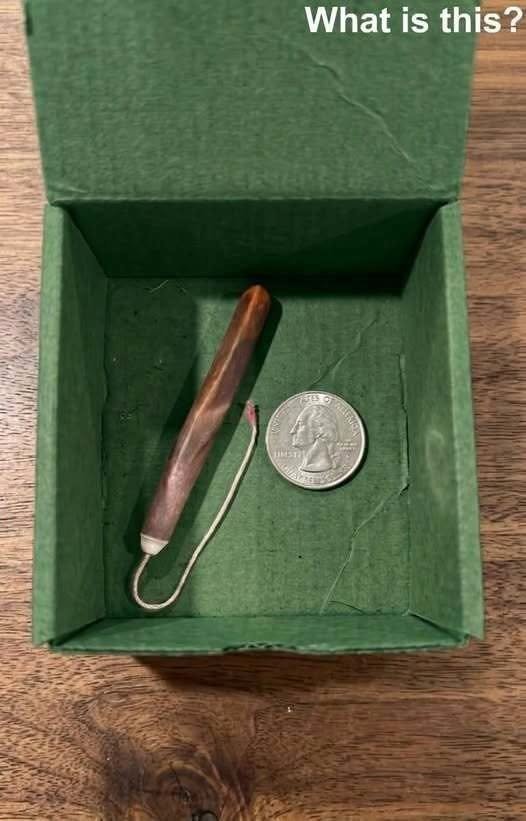
The tool in the photograph isn’t just a plain piece of metal.
Its handle appears to have decorative shaping, which isn’t unusual for historical personal grooming implements.
People have always turned everyday objects into beautifully designed possessions.
Museum collections contain ear spoons made from materials including:
Bronze
Silver
Ivory
Steel
Some were simple everyday tools, while others were incorporated into elaborate grooming sets.
🧳 They Could Be Part of Personal Grooming Kits
Before modern bathroom products became commonplace, people carried or stored small personal-care tools for grooming.
A compact tool that combined several functions could be particularly useful when traveling.
Historical examples include combinations such as:
ear spoon + tweezers
or
ear spoon + toothpick.
That explains why some mysterious objects found in old drawers look like they don’t quite belong to any modern category.
They were designed for a world where a person’s grooming kit could contain small specialized metal instruments.
🤯 Why Do People Mistake It for Something Else?
The shape is so unusual that modern viewers often guess completely different things.
Some might think it’s:
A tiny measuring spoon
A jewelry tool
A sewing accessory
A miniature medical instrument
A decorative object
A specialized craft tool
Without knowing the history of ear spoons, almost any guess seems reasonable.
The tiny bowl is the giveaway.
🏛️ These Aren’t Just Internet Curiosities
What’s particularly interesting is that these objects aren’t simply modern inventions being given a strange name online.
Major museums have actual historical examples in their collections.
The Met catalogs ancient and 19th-century ear spoons, while Princeton and the Science Museum Group preserve Roman and earlier examples.
That gives us a fascinating glimpse into how people approached personal hygiene long before today’s cotton swabs and modern bathroom products.
⚠️ Should You Actually Use an Antique Ear Spoon?
Absolutely not.
Even if an old object was originally designed for ear cleaning, an antique tool shouldn’t be inserted into the ear today.
Older metal can have corrosion, rough edges, unknown contamination, or microscopic damage that isn’t obvious from photographs.
More importantly, putting objects into the ear canal can cause injury or push earwax deeper.
If someone has troublesome earwax, hearing changes, pain, or a blocked sensation, it’s much safer to seek appropriate medical advice rather than experimenting with an antique tool.
🔎 How to Identify One Yourself
If you ever find a similar object in an old drawer, box, or antique collection, look for several clues.
1. A tiny rounded scoop
This is the biggest clue.
2. A long, narrow handle
Historical examples often have slender shafts.
3. Small overall dimensions
Many examples are only several inches long. Princeton’s Roman examples are approximately 11.9 and 14.3 centimeters long.
4. A second grooming tool
Some examples have tweezers, points, or other attachments.
5. Metal construction
Bronze, silver, steel, and other materials have all been used for these objects.
🕰️ A Tiny Object With a Very Long History
Perhaps the most fascinating thing about this little tool is how long the basic concept survived.
From ancient Roman examples to later European grooming sets, the ear spoon appears in different forms across different periods and cultures.
The technology is simple, but the object tells us something important about everyday life:
People in the past cared about personal grooming just as much as we do today.
They simply had very different tools for doing it.
Final Thoughts
That mysterious miniature spoon isn’t a tiny kitchen utensil after all.
It is consistent with a historical ear spoon or ear scoop, a personal-grooming implement traditionally used for removing earwax and other grooming purposes.
Examples preserved by major museums demonstrate that these tools have a history stretching back thousands of years.
What looks like a strange piece of metal today was once a perfectly ordinary personal-care tool.
And that’s what makes old objects so fascinating: something that seems completely useless to us can reveal an entire chapter of everyday life from the past.
👇 Did You Know This?
Have you ever seen an ear spoon like this before?
Or did you think it was something completely different?
Take your guess before reading the answer—and tell us what you thought it was in the comments! 👇🔎
To provide the best experiences, we use technologies like cookies to store and/or access device information. Consenting to these technologies will allow us to process data such as browsing behavior or unique IDs on this site. Not consenting or withdrawing consent, may adversely affect certain features and functions.
Functional
Always active
The technical storage or access is strictly necessary for the legitimate purpose of enabling the use of a specific service explicitly requested by the subscriber or user, or for the sole purpose of carrying out the transmission of a communication over an electronic communications network.
Preferences
The technical storage or access is necessary for the legitimate purpose of storing preferences that are not requested by the subscriber or user.
Statistics
The technical storage or access that is used exclusively for statistical purposes.The technical storage or access that is used exclusively for anonymous statistical purposes. Without a subpoena, voluntary compliance on the part of your Internet Service Provider, or additional records from a third party, information stored or retrieved for this purpose alone cannot usually be used to identify you.
Marketing
The technical storage or access is required to create user profiles to send advertising, or to track the user on a website or across several websites for similar marketing purposes.