The Most Parasite-Contaminated Vegetable? What You Should Really Know
❌ Don’t Wash Vegetables With Soap or Bleach
This is an important point.
Some people believe that using dish soap, detergent or bleach will make vegetables safer.
Don’t do this.
The FDA specifically advises against washing fruits and vegetables with soap, detergent or household cleaning products. Produce can absorb these substances, potentially making you sick. (U.S. Food and Drug Administration)
Plain running water is the recommended household method for washing fresh produce.
🔥 Is Cooking Safer Than Eating Vegetables Raw?
In many circumstances, proper cooking can significantly reduce the risk of foodborne illness.
The CDC notes that cooking produce can kill parasites such as Cyclospora when sufficiently high temperatures are reached. (CDC)
This is especially worth considering for people who are more vulnerable to foodborne illness, including:
Young children
Adults over 65
Pregnant women
People with weakened immune systems
These groups can experience more serious consequences from foodborne infections. (CDC)
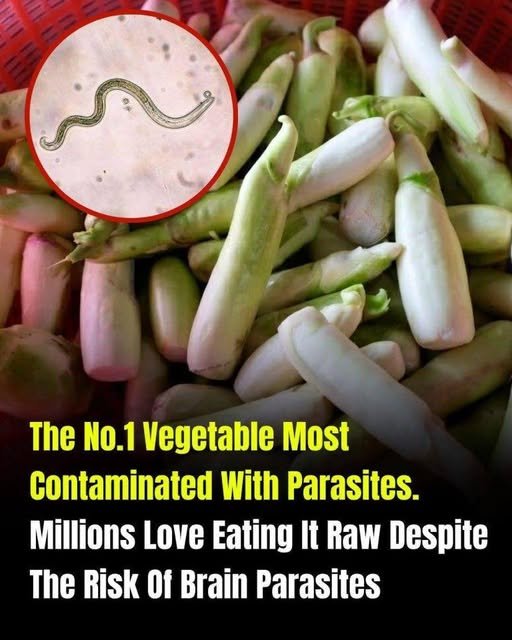
🌱 What About the Vegetable Shown in the Viral Image?
The image accompanying this viral claim is designed to make the viewer believe that a particular vegetable is uniquely dangerous.
However, the photograph itself cannot establish that the vegetable is “No. 1” for parasite contamination.
Food contamination is not determined simply by the appearance of a vegetable. Laboratory testing, geographic information and epidemiological data are needed to determine the actual risk.
So rather than being afraid of one specific vegetable, it is better to follow good food-safety practices with all fresh produce.
🥗 Should You Stop Eating Fresh Vegetables?
Absolutely not.
Vegetables provide fiber, vitamins, minerals and other beneficial nutrients and remain an important part of a balanced diet.
The goal isn’t to avoid vegetables. It’s to handle them properly.
The CDC identifies unwashed fruits and vegetables as a riskier food choice and recommends washed produce as the safer option. (CDC)
🧼 A Simple Produce-Safety Routine
Whenever you bring fresh vegetables home:
1. Wash your hands. 2. Keep produce away from raw meat and seafood. 3. Rinse vegetables under clean running water. 4. Remove damaged or spoiled portions. 5. Use clean knives and cutting boards. 6. Refrigerate perishable prepared produce promptly. 7. Cook vegetables when appropriate, especially if you’re concerned about contamination.
These simple habits can greatly reduce unnecessary food-safety risks.
⚠️ What About “Brain Parasites”?
The phrase “brain parasites” is often used in viral posts because it sounds frightening.
Some parasites can cause serious disease and, in certain circumstances, can affect the nervous system. However, that does not mean that eating an ordinary raw vegetable automatically exposes someone to a brain infection.
The specific parasite, route of transmission, geographic location and level of exposure all matter.
This is why sensational claims that one vegetable routinely causes “brain parasites” should be treated with caution.
🚨 When Should You Seek Medical Advice?
If someone develops persistent diarrhea, abdominal pain, unexplained weight loss, fever or other concerning symptoms after a suspected foodborne exposure, they should speak with a healthcare professional.
People who are pregnant, elderly, very young, or immunocompromised should take suspected foodborne illness particularly seriously.
Final Thoughts
The claim that there is one vegetable that is “the most contaminated with parasites” is an oversimplification.
Fresh vegetables can become contaminated with bacteria, viruses or parasites under certain conditions, especially when exposed to contaminated soil or water or when handled improperly. (CDC)
But you don’t need to eliminate vegetables from your diet.
Wash your produce properly, keep your kitchen clean, prevent cross-contamination and cook foods when appropriate.
Those simple habits are far more useful than worrying about a single “dangerous” vegetable.
💬 Do you usually eat your vegetables raw or cooked?
And what is the vegetable you always make sure to wash extra carefully?
Share your thoughts in the comments below. 👇
Medical disclaimer: This article is for general educational purposes and does not diagnose or treat parasitic infections. If you have symptoms or concerns about a possible foodborne infection, consult a qualified healthcare professional.
To provide the best experiences, we use technologies like cookies to store and/or access device information. Consenting to these technologies will allow us to process data such as browsing behavior or unique IDs on this site. Not consenting or withdrawing consent, may adversely affect certain features and functions.
Functional
Always active
The technical storage or access is strictly necessary for the legitimate purpose of enabling the use of a specific service explicitly requested by the subscriber or user, or for the sole purpose of carrying out the transmission of a communication over an electronic communications network.
Preferences
The technical storage or access is necessary for the legitimate purpose of storing preferences that are not requested by the subscriber or user.
Statistics
The technical storage or access that is used exclusively for statistical purposes.The technical storage or access that is used exclusively for anonymous statistical purposes. Without a subpoena, voluntary compliance on the part of your Internet Service Provider, or additional records from a third party, information stored or retrieved for this purpose alone cannot usually be used to identify you.
Marketing
The technical storage or access is required to create user profiles to send advertising, or to track the user on a website or across several websites for similar marketing purposes.