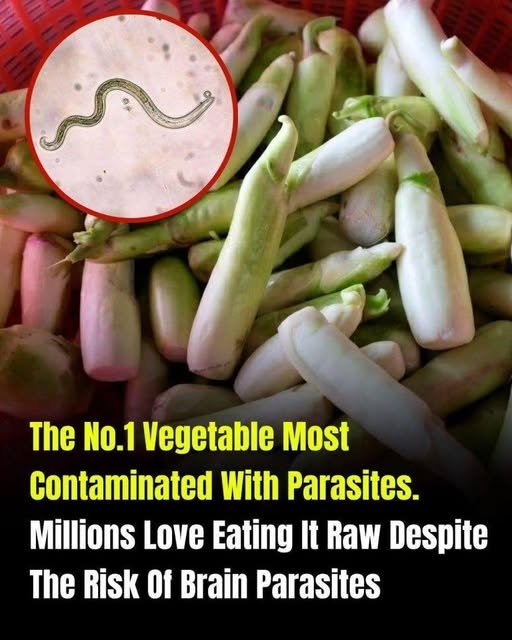
The Most Parasite-Contaminated Vegetable? What You Should Really Know
Fresh vegetables are an important part of a healthy diet, but viral posts sometimes claim that one particular vegetable is “the most contaminated with parasites” and can expose people to dangerous infections.
The truth is more nuanced.
There is no universally recognized “No. 1 vegetable” that is always the most contaminated with parasites. The risk depends on where produce was grown, the quality of irrigation water, soil contamination, handling, storage, and whether the vegetable is eaten raw or cooked. The CDC notes that parasites can contaminate raw vegetables when they come into contact with contaminated soil, water, or human or animal fecal matter. (CDC)
That doesn’t mean you should stop eating vegetables. In fact, fresh produce remains an important part of a healthy diet. The key is proper preparation.
🥬 Why Can Raw Vegetables Carry Parasites?
Vegetables are grown outdoors and can come into contact with soil, irrigation water, animals, insects, farm equipment and human hands.
Some parasites can be transmitted through contaminated food or water. The CDC lists organisms such as Cyclospora, Cryptosporidium, Giardia and Toxoplasma gondii among parasites that can be transmitted through food or water. (CDC)
Certain raw vegetables and aquatic plants can have a higher potential risk when they are grown or handled in environments where contamination is possible. But that doesn’t mean every vegetable of that type is contaminated.
🦠 Does Eating a Vegetable Raw Mean You Will Get Parasites?
No.
Finding parasites or harmful microorganisms on produce is a food-safety concern, but exposure does not automatically mean infection.
The risk can be reduced substantially through good food-handling practices.
The CDC specifically recommends washing fruits and vegetables thoroughly under running water before eating, cutting or cooking them. (CDC)
For certain vegetables, cooking provides an additional level of protection because adequate heat can kill many harmful microorganisms.
🚿 How to Wash Vegetables Properly
One of the easiest ways to make fresh produce safer is also one of the simplest.
Step 1: Wash your hands
Before preparing vegetables, wash your hands with soap and water for at least 20 seconds.
Step 2: Rinse under running water
Place the vegetables under clean, running water and gently rub the surfaces with your hands.
The FDA recommends washing fresh produce thoroughly under running water before preparing or eating it. (U.S. Food and Drug Administration)
Step 3: Remove damaged portions
Cut away bruised, damaged or visibly spoiled areas.
Step 4: Dry the produce
Drying with a clean towel or paper towel can help remove additional contamination from the surface. (U.S. Food and Drug Administration)
To provide the best experiences, we use technologies like cookies to store and/or access device information. Consenting to these technologies will allow us to process data such as browsing behavior or unique IDs on this site. Not consenting or withdrawing consent, may adversely affect certain features and functions.
Functional
Always active
The technical storage or access is strictly necessary for the legitimate purpose of enabling the use of a specific service explicitly requested by the subscriber or user, or for the sole purpose of carrying out the transmission of a communication over an electronic communications network.
Preferences
The technical storage or access is necessary for the legitimate purpose of storing preferences that are not requested by the subscriber or user.
Statistics
The technical storage or access that is used exclusively for statistical purposes.The technical storage or access that is used exclusively for anonymous statistical purposes. Without a subpoena, voluntary compliance on the part of your Internet Service Provider, or additional records from a third party, information stored or retrieved for this purpose alone cannot usually be used to identify you.
Marketing
The technical storage or access is required to create user profiles to send advertising, or to track the user on a website or across several websites for similar marketing purposes.