Think You’re Buying Real Honey? Here’s What the Bottle Flip Test Really Tells You
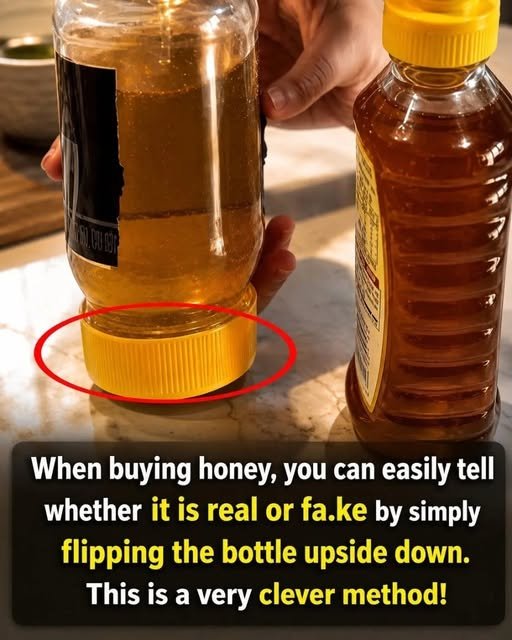
There’s a popular trick circulating online that claims you can tell whether honey is real or fake simply by turning the bottle upside down.
The idea looks convincing: flip the container, watch how the honey moves, and supposedly you can determine whether you’re holding genuine honey or a syrup-based imitation.
But there’s an important problem with this viral “test”:
The way honey moves in a bottle cannot reliably prove whether it is authentic.
And understanding why can help you avoid being fooled by misleading food hacks.
🍯 Can You Really Test Honey by Flipping the Bottle?
Not reliably.
When you turn a honey container upside down, the honey may move slowly, quickly, or remain relatively thick depending on several factors.
These include:
Temperature
Moisture content
Honey variety
Glucose-to-fructose ratio
Storage conditions
Crystallization
Container shape
Viscosity
That means two completely genuine honeys can behave very differently when you flip their bottles.
The USDA describes honey as naturally varying in consistency from fluid and viscous to partly or completely crystallized. (USDA AMS)
So a slow-moving honey isn’t automatically “real,” and a faster-moving honey isn’t automatically fake.
🧪 Why the Viral Test Sounds Convincing
The claim usually goes something like this:
“Real honey is thick, so it should move slowly when you turn the bottle upside down.”
There’s a little truth hidden inside that statement.
Honey is viscous, meaning it can resist flowing.
But viscosity isn’t the same thing as authenticity.
A genuine honey can become more fluid when warm and thicker when cold. Different varieties can also have noticeably different physical properties.
In other words, how fast honey flows tells you something about its physical condition—not whether someone secretly added another sweetener to it.
🌡️ Temperature Can Change Everything
Imagine taking one jar of genuine honey and placing it in a cool cupboard.
Then take another jar of the same honey and warm it.
Flip both containers.
They may behave very differently.
The warmer honey will generally flow more easily, while cooler honey will be thicker.
This is one reason a simple bottle-flip demonstration cannot function as a reliable authenticity test.
❄️ What About Crystallized Honey?
Here’s another common misconception.
Some people believe that crystallized honey is fake.
That’s not true.
The USDA explains that honey is naturally a supersaturated glucose solution and that most honey will naturally granulate or crystallize. The rate depends on factors including the fructose-to-glucose ratio and storage temperature. Importantly, the USDA states that crystallization is not an indicator of adulteration. (USDA AMS)
So if your honey becomes cloudy or develops crystals, that doesn’t mean you’ve been cheated.
In fact, natural crystallization is a normal characteristic of many honeys.
🐝 What Does “Real Honey” Actually Mean?
Honey is produced by honey bees from plant nectar or other plant-derived secretions, which the bees collect, transform, deposit, dehydrate, and store in honeycombs.
Its natural characteristics can vary considerably.
Color can range from nearly colorless to dark brown, while consistency can range from liquid to partially or completely crystallized. (USDA AMS)
That natural variation is important.
There isn’t one universal appearance that every genuine honey must have.
🚨 But Fake or Adulterated Honey Does Exist
This part of the viral claim has a real foundation.
Honey can be subject to economically motivated adulteration, meaning cheaper sweeteners are added without being properly declared.
The FDA specifically monitors honey for undeclared sweeteners such as syrups derived from sugarcane, corn, rice, or sugar beets. (U.S. Food and Drug Administration)
In its most recent FY2025 sampling assignment, the FDA tested 102 honey samples for certain forms of adulteration and found four violative samples—two domestic and two imported. (U.S. Food and Drug Administration)
So the concern about honey authenticity isn’t imaginary.
The problem is that the bottle-flip trick isn’t a scientifically reliable way to solve it.
🔬 How Do Experts Actually Test Honey?
Laboratories can use analytical techniques that are far more sophisticated than looking at how quickly honey flows.
For example, the FDA’s FY2025 honey testing used Stable Carbon Isotope Ratio Analysis (SCIRA) to examine honey and its protein extract for patterns that could indicate undeclared added sweeteners. (U.S. Food and Drug Administration)
This is very different from a kitchen experiment.
Laboratory testing can take into account natural variation in honey and analytical uncertainty before determining whether a sample is considered violative. (U.S. Food and Drug Administration)
That’s why a visual trick shouldn’t be presented as a definitive authenticity test.
🏷️ The Label Is More Useful Than a Viral Hack
When buying packaged honey, start with the information provided on the product rather than relying on an internet trick.
Look at:
The ingredient information
If a product is marketed simply as honey, check what the package actually says.
The producer
A transparent producer who provides information about the source of the honey can give you more confidence.
The origin
Information about where the honey came from can be useful, particularly when buying directly from a beekeeper or established producer.
The packaging
Avoid products with damaged or questionable packaging.
🍯 Does Thick Honey Mean Better Honey?
Not necessarily.
Thickness isn’t a quality ranking system.
Some genuine honey varieties are naturally thicker than others, and temperature can substantially affect how honey flows.
The USDA’s honey standards specifically recognize differences in consistency, color, flavor, aroma, and crystallization. (USDA AMS)
So don’t automatically assume:
Thick = real
or
Thin = fake.
Neither conclusion is justified by viscosity alone.
🫧 What About the Bubble Test?
Another popular internet trick involves shaking honey and looking at the bubbles.
Again, bubbles aren’t a definitive authenticity test.
Air bubbles can naturally occur in honey. The USDA’s standards for extracted honey explicitly discuss visible air bubbles as a normal characteristic that can occur in honey. (USDA AMS)
So seeing bubbles doesn’t prove that the product is genuine or fake.
🥄 What About the Water Test?
You may also have seen videos showing honey being dropped into a glass of water.
The theory is usually that genuine honey will remain together while fake honey dissolves rapidly.
But just like the bottle-flip method, this isn’t a dependable laboratory test.
Honey’s behavior in water can be influenced by its composition, temperature, moisture content, and the conditions of the experiment.
A kitchen demonstration might be interesting, but it shouldn’t be used as proof of authenticity.
🤔 Why Do These Honey Hacks Spread So Easily?
Because they’re simple.
You don’t need special equipment.
You don’t need a laboratory.
All you need is a bottle of honey and a glass of water—or, in this case, simply your hands.
That’s perfect for social media.
But easy to demonstrate doesn’t mean scientifically accurate.
A useful rule for viral food hacks is:
If a test claims to identify a complex food fraud problem using one simple visual trick, be skeptical.
🛒 So How Can You Make a Better Buying Decision?
Instead of relying on one viral test, use several pieces of information together.
Choose honey from a reputable producer, examine the label carefully, consider the stated origin, and buy from a beekeeper or trusted supplier when possible.
If you need definitive confirmation of authenticity, laboratory analysis is the appropriate approach, not a bottle-flip experiment.
Final Thoughts
The bottle-flip trick shown in the image is certainly interesting—but it cannot reliably tell you whether honey is real or adulterated.
Honey naturally varies in thickness and can become more or less fluid depending on temperature and composition. It can also crystallize naturally, and crystallization itself is not evidence that honey is fake. (USDA AMS)
At the same time, honey adulteration is a genuine food-fraud issue, and regulators such as the FDA actively test honey for undeclared added sweeteners. (U.S. Food and Drug Administration)
So next time you see someone say, “Just flip the bottle and you’ll know,” remember:
The way honey flows can tell you about its physical properties—but it can’t tell you the whole story about what’s inside.
🍯 Have You Tried This Viral Honey Trick?
Have you ever tested honey by flipping the bottle, dropping it in water, or watching the bubbles?
Tell us what happened with yours in the comments. 👇
To provide the best experiences, we use technologies like cookies to store and/or access device information. Consenting to these technologies will allow us to process data such as browsing behavior or unique IDs on this site. Not consenting or withdrawing consent, may adversely affect certain features and functions.
Functional
Always active
The technical storage or access is strictly necessary for the legitimate purpose of enabling the use of a specific service explicitly requested by the subscriber or user, or for the sole purpose of carrying out the transmission of a communication over an electronic communications network.
Preferences
The technical storage or access is necessary for the legitimate purpose of storing preferences that are not requested by the subscriber or user.
Statistics
The technical storage or access that is used exclusively for statistical purposes.The technical storage or access that is used exclusively for anonymous statistical purposes. Without a subpoena, voluntary compliance on the part of your Internet Service Provider, or additional records from a third party, information stored or retrieved for this purpose alone cannot usually be used to identify you.
Marketing
The technical storage or access is required to create user profiles to send advertising, or to track the user on a website or across several websites for similar marketing purposes.