The Hidden Meaning Behind One of History’s Oldest Hand Gestures
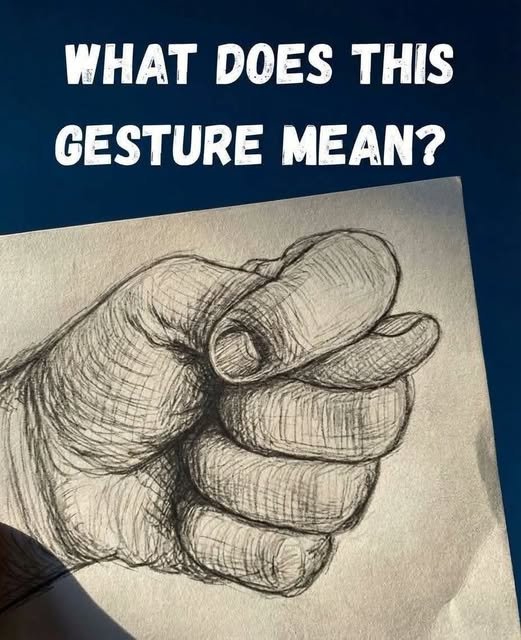
At first glance, this may look like a simple closed fist. But the small detail—the thumb tucked between the index and middle fingers—turns it into one of the oldest and most culturally interesting hand gestures.
It is commonly known as the “fig sign” or mano fico. Its meaning has changed dramatically depending on the culture and historical period. (Wikipédia)
✋ What Does the Gesture Mean?
There isn’t one universal meaning.
Historically, the gesture has been associated with:
Protection from the evil eye
Good luck
Refusing a request
Defiance or rejection
And, in some cultures, a rude or obscene insult (Wikipédia)
That is what makes this gesture so fascinating: the exact same hand position can be harmless in one place and deeply offensive in another.
🏛️ A Gesture With Ancient Roots
The fig sign was already known in the ancient Mediterranean world.
In ancient Rome, it was associated with the manus fica and was used in rituals intended to protect against harmful spirits. Ancient Greeks also used representations of the gesture as protective charms associated with fertility and protection from the evil eye. (Wikipédia)
The gesture’s symbolism was connected partly to the shape of the hand and the fig itself, which had important cultural and religious associations in the ancient Mediterranean.
🧿 A Symbol of Protection
One of its most interesting historical roles was apotropaic—a gesture believed to protect someone from evil or misfortune.
People could wear small representations of the hand as amulets, particularly in Mediterranean traditions.
So what might look like an insult today could once have been intended as a protective symbol.
😮 But It Could Also Be Offensive
The meaning eventually developed in very different directions across different regions.
In some cultures, the gesture became a way of saying essentially “no,” “nothing for you,” or “absolutely not.” In others, it became a vulgar or insulting gesture. (symbols.com)
This is why gestures shouldn’t always be interpreted using the customs of your own country.
👶 And There Is an Innocent Version
In some places, the same hand position is used in children’s games, particularly the familiar “I’ve got your nose” trick.
In that context, there is nothing offensive about it at all. (Wikipédia)
🌍 Why Context Matters
A hand gesture can travel across centuries and cultures while its meaning changes completely.
The fig sign is a perfect example.
What began as an ancient symbol associated with protection, fertility and superstition later became a gesture of refusal or insult in various cultures, while remaining playful in others. (Wikipédia)
So the next time you see someone making this gesture, don’t immediately assume you know what they mean.
The country, culture, situation and even the direction of the hand can change its meaning.
🤔 Did you know what this gesture meant before reading this?
The historical meaning of gestures is complex, and interpretations can vary by region and period. This article describes documented uses rather than suggesting that the gesture has one universal meaning.
To provide the best experiences, we use technologies like cookies to store and/or access device information. Consenting to these technologies will allow us to process data such as browsing behavior or unique IDs on this site. Not consenting or withdrawing consent, may adversely affect certain features and functions.
Functional
Always active
The technical storage or access is strictly necessary for the legitimate purpose of enabling the use of a specific service explicitly requested by the subscriber or user, or for the sole purpose of carrying out the transmission of a communication over an electronic communications network.
Preferences
The technical storage or access is necessary for the legitimate purpose of storing preferences that are not requested by the subscriber or user.
Statistics
The technical storage or access that is used exclusively for statistical purposes.The technical storage or access that is used exclusively for anonymous statistical purposes. Without a subpoena, voluntary compliance on the part of your Internet Service Provider, or additional records from a third party, information stored or retrieved for this purpose alone cannot usually be used to identify you.
Marketing
The technical storage or access is required to create user profiles to send advertising, or to track the user on a website or across several websites for similar marketing purposes.