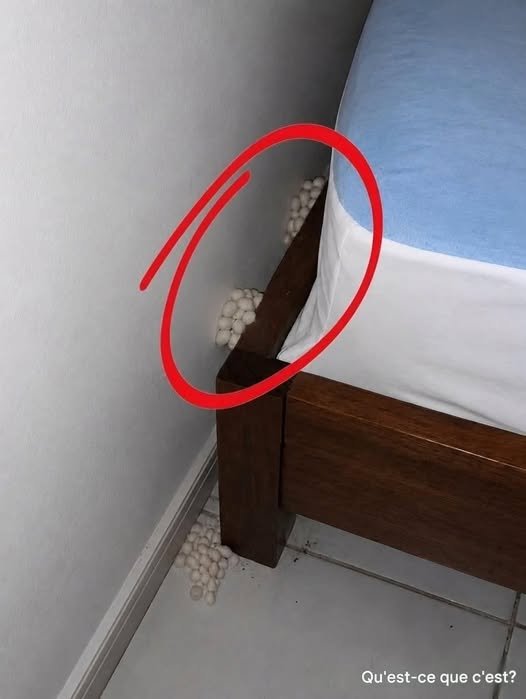
I Found These Strange Little Brown Objects on My Bed — What Are They?
🥚 What About Cockroach Egg Cases?
Another common assumption is that these could be cockroach eggs.
Cockroach egg cases, called oothecae, generally have a much more distinctive capsule-like appearance and often show a ridged or segmented edge.
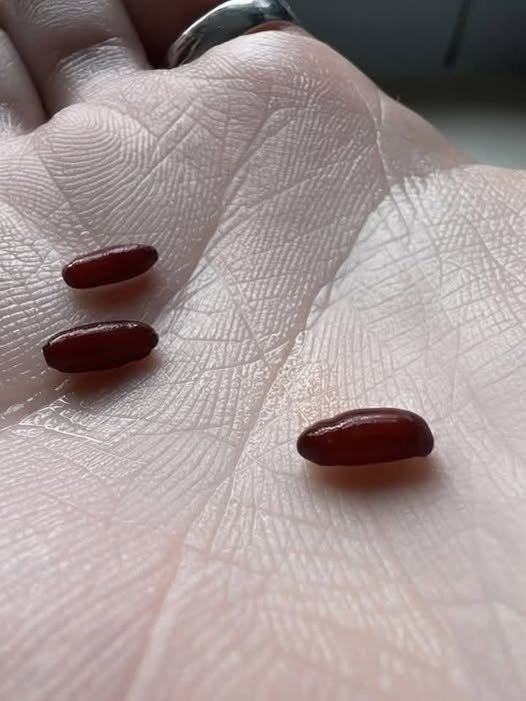
The smooth, bean-like appearance in this photograph doesn’t strongly match the classic appearance people associate with cockroach egg cases.
Again, a close-up photograph alone isn’t enough to make a definitive identification.
🌱 Could They Actually Be Seeds?
Absolutely.
Small seeds can easily find their way into bedrooms through:
Clothing
Pets
Shoes
Bedding
Open windows
Bags and backpacks
Outdoor activities
Some plant seeds are naturally smooth, shiny, and reddish-brown.
If the objects are hard, completely smooth, don’t move, and appear repeatedly without any other insect evidence, a seed or other harmless object becomes a reasonable possibility.
🧸 Another Possibility: Material From Bedding
There’s another explanation that is easy to overlook.
Small objects can sometimes come from:
Pillows
Mattresses
Weighted blankets
Stuffed items
Clothing
Decorative cushions
If a seam has opened, small pieces of filling or embedded material can escape.
This is especially worth checking if the objects keep appearing in exactly the same area.
🔬 How Can You Figure Out What They Are?
Before throwing them away, examine one carefully.
1. Check whether it moves
If it moves on its own, it’s obviously more likely to be biological.
If it remains completely stationary, consider seeds, debris, or another material.
2. Look for legs
Use your phone’s camera zoom or a magnifying glass.
An insect should have recognizable legs and other body structures.
3. Check the texture
Ask yourself:
Is it hard like a seed?
Is it soft?
Does it have a shell?
Does it crush easily?
These details can dramatically narrow down the possibilities.
4. Check your bedding
Look carefully at:
Mattress seams
Mattress tags
Bed-frame joints
Headboard
Box spring
Sheets
Nearby furniture
If you’re concerned about bed bugs, don’t rely on a single mysterious object. Look for multiple signs.
🚨 Signs That Actually Point Toward Bed Bugs
The EPA recommends looking for several physical clues when inspecting for bed bugs.
These include:
🩸 Rust-colored stains
Small reddish stains can appear on sheets or mattresses when bed bugs are crushed.
⚫ Dark spots
Bed bug feces can appear as tiny dark spots and may bleed into fabric similarly to ink. (US EPA)
🥚 Pale eggs or eggshells
Bed bug eggs are tiny and pale, generally around 1 mm. (US EPA)
🐜 Live insects
Finding an actual bed bug is much stronger evidence than finding an unidentified brown object.
🛏️ Don’t Panic After Finding One Mystery Object
This is probably the most important point.
One unexplained object does not automatically mean you have bed bugs.
There are many things that can end up in bedding or on a mattress.
If you don’t find live insects, eggs, dark fecal spotting, shed skins, or other evidence, there’s no reason to immediately assume you have an infestation.
🧹 What Should You Do Now?
Start with a simple inspection.
Remove the bedding and wash it according to the care label.
Inspect the mattress seams with a flashlight.
Check the bed frame and headboard.
Vacuum around the bed and nearby floor.
Inspect pillows, blankets, and nearby furniture.
Keep any suspicious object in a small container if you want it identified later.
If you repeatedly discover suspicious insects or evidence, consider contacting a qualified pest professional.
📸 A Better Way to Identify Mystery Objects
If you want someone to identify something like this, a photograph with a coin or ruler beside the object is extremely helpful.
Try to include:
One close-up photograph
One photo showing its actual size
The location where you found it
Whether it moves
Whether it feels hard or soft
Whether you found one or several
These details can be much more useful than a photograph alone.
Final Thoughts
The objects shown in the image do not resemble typical bed bug eggs, which are tiny and pearl-white. (US EPA)
They could potentially be seeds, small pieces of material, insect-related debris, or another harmless object. Without additional information—especially their exact size, texture, and whether they move—it’s not possible to identify them with certainty.
If you’re worried about bed bugs, focus on the combination of evidence, rather than one mysterious object.
And remember: finding something strange on your bed doesn’t automatically mean you have an infestation.
👀 Have you ever found something mysterious in your bedding?
What did you think it was at first—and what did it turn out to be?
To provide the best experiences, we use technologies like cookies to store and/or access device information. Consenting to these technologies will allow us to process data such as browsing behavior or unique IDs on this site. Not consenting or withdrawing consent, may adversely affect certain features and functions.
Functional
Always active
The technical storage or access is strictly necessary for the legitimate purpose of enabling the use of a specific service explicitly requested by the subscriber or user, or for the sole purpose of carrying out the transmission of a communication over an electronic communications network.
Preferences
The technical storage or access is necessary for the legitimate purpose of storing preferences that are not requested by the subscriber or user.
Statistics
The technical storage or access that is used exclusively for statistical purposes.The technical storage or access that is used exclusively for anonymous statistical purposes. Without a subpoena, voluntary compliance on the part of your Internet Service Provider, or additional records from a third party, information stored or retrieved for this purpose alone cannot usually be used to identify you.
Marketing
The technical storage or access is required to create user profiles to send advertising, or to track the user on a website or across several websites for similar marketing purposes.