I Found These Strange Plastic Pieces in Grandma’s Drawer — What Are They?
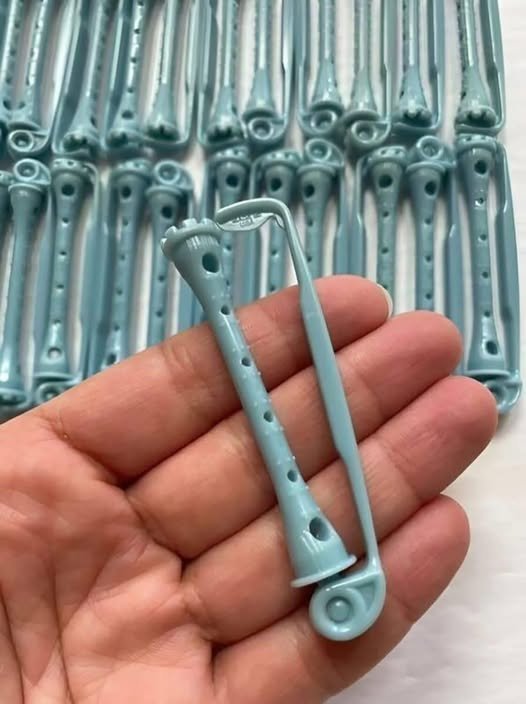
The holes aren’t random.
They help make the plastic piece lightweight and flexible, while also allowing it to work effectively with different types of rollers.
The elongated design also makes the pin easier to handle than a tiny conventional hairpin.
Vintage examples are documented as plastic “roller pins,” and similar sets can still be found among collections of retro hair-styling equipment. (eBay)
👵 Why Would Grandma Have So Many?
Now the drawer makes a lot more sense.
If someone regularly set their hair with rollers, they would need many pins at the same time.
A complete hairstyle could require numerous rollers, meaning a drawer full of these little plastic pieces wouldn’t have been unusual.
In fact, vintage packages were sometimes sold with multiple rollers and several matching plastic hairpins. One documented 1950s Curlasette set included plastic curlers together with six plastic hairpins. (Etsy)
🕰️ A Forgotten Part of Old-Fashioned Hair Styling
Today, someone can create curls with a curling iron, heated brush, automatic curler, or other modern styling device in a matter of minutes.
Earlier generations often relied on a completely different routine.
Hair rollers, setting lotions, pins, and patience were part of the process.
Women might put their hair in rollers in the evening and sleep with them overnight, or wear them while getting ready for an important occasion.
The goal was a hairstyle with defined curls, waves, or volume.
💡 They Were Surprisingly Useful Beyond Hair
Interestingly, these large blunt plastic pins didn’t always remain in the beauty drawer.
Because they are flexible and don’t have sharp points like conventional sewing pins, similar plastic pins have also been used for crafting and textile work, including temporarily holding knitted pieces together. (DatoCMS)
That means someone finding these in an old craft or sewing drawer might have been using them for a completely different purpose.
🔍 How Can You Tell They’re Hair-Curler Pins?
Several clues point toward their original use:
✔️ Long, narrow shape ✔️ Blunt plastic construction ✔️ Multiple holes along the shaft ✔️ Curved/looped fastening end ✔️ Large quantities stored together ✔️ Designed to work with rollers
The strongest clue is the shape of the fastening end, which is designed to secure the pin rather than function like an ordinary straight sewing needle.
🧴 Why Plastic Instead of Metal?
Plastic had some advantages for hair styling.
A plastic pin was:
Lightweight
Less likely to scratch the scalp
Easy to manufacture
Flexible
Reusable
Less likely to snag hair than some metal designs
Historical hairpin patents also describe plastic hairpins designed specifically for holding curls, including designs intended to make the pin easier to open and position with the fingers. (Brevet Google)
📸 A Great Example of “Mystery Object” History
This is exactly the kind of object that can leave younger generations completely confused.
Someone today sees a strange piece of perforated plastic and thinks:
“What on earth is this?”
Someone who grew up using rollers may recognize it instantly.
That’s what makes old household objects so fascinating. Their purpose can disappear from everyday life surprisingly quickly.
Final Answer
Those mysterious plastic pieces are old-fashioned hair-curler pins / roller pins.
They were used with hair rollers to secure curls while the hair was setting, helping create the classic curled and voluminous hairstyles that were popular for decades. Vintage Curlasette products, for example, were sold specifically with plastic hairpins for hair setting and styling. (Etsy)
So they weren’t waste at all.
They were once an essential little part of the classic roller-and-set hairstyle. 💇♀️🌀
👇 Did Your Grandma Use These?
Have you ever seen these plastic pins before?
Maybe your mother, grandmother, or another family member used them when setting their hair.
Did you know what they were—or did you think they were just random pieces of plastic? 😄
To provide the best experiences, we use technologies like cookies to store and/or access device information. Consenting to these technologies will allow us to process data such as browsing behavior or unique IDs on this site. Not consenting or withdrawing consent, may adversely affect certain features and functions.
Functional
Always active
The technical storage or access is strictly necessary for the legitimate purpose of enabling the use of a specific service explicitly requested by the subscriber or user, or for the sole purpose of carrying out the transmission of a communication over an electronic communications network.
Preferences
The technical storage or access is necessary for the legitimate purpose of storing preferences that are not requested by the subscriber or user.
Statistics
The technical storage or access that is used exclusively for statistical purposes.The technical storage or access that is used exclusively for anonymous statistical purposes. Without a subpoena, voluntary compliance on the part of your Internet Service Provider, or additional records from a third party, information stored or retrieved for this purpose alone cannot usually be used to identify you.
Marketing
The technical storage or access is required to create user profiles to send advertising, or to track the user on a website or across several websites for similar marketing purposes.