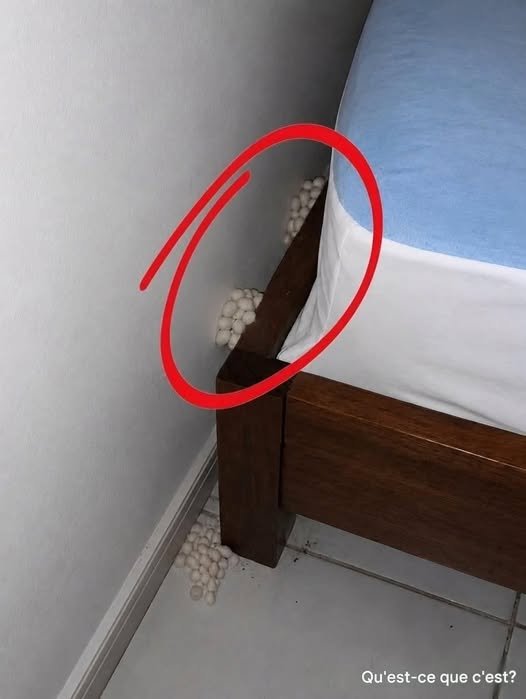
I Came Home Exhausted, Then Noticed Something Strange Under My Bed
Take a bright flashlight and carefully examine the bed.
Start with the mattress.
Check the mattress seams
Look closely along the piping and folds around the mattress.
You’re looking for:
Tiny pearly-white eggs
Dark spotting
Shed insect skins
Live insects
Rust-colored stains
Bed bug eggs are only about 1 mm long, so a magnifying glass or your phone’s macro camera can make identification much easier. (CALS)
Check the bed frame
Next, inspect:
Wooden joints
Screw holes
Cracks
Undersides of the frame
Areas where the mattress touches the frame
These protected spaces can provide hiding places for pests.
🐜 What About Other Insects?
Not every small white object near a bed is associated with bed bugs.
For example, carpet beetle eggs can also be small and pale and may occur around carpets, furniture, closets, and natural-fiber materials. Their eggs are generally smaller than bed bug eggs and can have distinctive surface projections that are difficult to see without magnification. (Insectio)
Other possibilities include:
Dust or debris
Dried residue
Paint or plaster particles
Mold or fungal material
Insect remains
Eggs from another species
That’s why location, size, shape, texture, and surrounding evidence all matter.
❗ Don’t Panic If You Find Something Suspicious
Finding unexplained material around your bed doesn’t automatically mean you have an infestation.
Instead, take a systematic approach.
Step 1: Photograph it
Take clear close-up photographs before disturbing the material.
Include something for scale, such as a coin or ruler.
Step 2: Inspect the surrounding area
Check the mattress, headboard, bed frame, nearby furniture, and baseboards.
Step 3: Look for multiple signs
One unidentified object is much less informative than finding several different signs together.
For bed bugs, for example, eggs may be accompanied by adults, nymphs, shed skins, or dark fecal spotting. (CALS)
Step 4: Avoid spreading the material
Don’t sweep suspicious material throughout the bedroom.
If you’re dealing with a suspected pest problem, keep the area contained while you determine what you’re looking at.
🧹 Should You Vacuum Everything Immediately?
Cleaning your bedroom is always a good idea, but vacuuming alone should not be considered a complete solution if you actually have a pest infestation.
If you suspect bed bugs, identifying the pest first is important because different insects require different control methods.
A professional pest inspection can be especially useful when you continue finding suspicious material or live insects.
🛑 When Should You Take It More Seriously?
Pay closer attention if you notice:
New unexplained bites or skin irritation
Live insects
Repeated clusters of suspicious material
Dark spots around mattress seams
Shed insect skins
A persistent pest problem despite cleaning
Similar findings in multiple rooms
If you keep finding evidence around the bed, consider having the area professionally inspected.
🔬 The Most Important Lesson
One photograph is often not enough to identify an unknown substance or insect egg with certainty.
That’s especially true when the objects are photographed from a distance.
Bed bug eggs have a very specific appearance: they are tiny, approximately 1 mm, whitish, oval, and commonly attached to surfaces in protected areas. (CALS)
If the objects you’re seeing are substantially larger, loose rather than glued down, or arranged differently, another explanation may be more likely.
🏠 A Simple Bedroom Inspection Routine
Even if you don’t see anything suspicious, checking your sleeping area occasionally is a good habit.
Move the bed slightly away from the wall and inspect:
✔️ Mattress seams ✔️ Bed-frame joints ✔️ Headboard connections ✔️ Baseboards ✔️ Under the bed ✔️ Nearby upholstered furniture
Use a flashlight and look carefully rather than relying on a quick glance.
Final Thoughts
Those mysterious white clusters near the bed certainly deserve a closer look—but they should not automatically be labeled as bed bug eggs.
True bed bug eggs are tiny, usually around 1 mm, pale or pearly white, and often firmly attached in protected cracks and crevices. (CALS)
If you discover something similar in your own bedroom, the best first step is simple:
Don’t panic. Take a close-up photo, inspect the surrounding area, and look for additional evidence before deciding what you’re dealing with.
And if suspicious signs continue appearing, a qualified pest professional can help identify the cause and recommend the appropriate treatment.
👀 Have you ever found strange white spots or clusters around your bed?
Did you figure out what they were? Share your experience in the comments. 👇
SEO title: What Are These White Specks Under the Bed? Possible Causes Explained Meta description: Found tiny white clusters around your bed frame? Learn what they could be, how to inspect for bed bugs, and when it’s time to call a pest professional. Suggested URL slug:white-specks-under-bed-what-are-they Primary keyword: white specks under bed Secondary keywords: white spots on bed frame, bed bug eggs, tiny white eggs in bed, pests under bed, bed frame inspection
To provide the best experiences, we use technologies like cookies to store and/or access device information. Consenting to these technologies will allow us to process data such as browsing behavior or unique IDs on this site. Not consenting or withdrawing consent, may adversely affect certain features and functions.
Functional
Always active
The technical storage or access is strictly necessary for the legitimate purpose of enabling the use of a specific service explicitly requested by the subscriber or user, or for the sole purpose of carrying out the transmission of a communication over an electronic communications network.
Preferences
The technical storage or access is necessary for the legitimate purpose of storing preferences that are not requested by the subscriber or user.
Statistics
The technical storage or access that is used exclusively for statistical purposes.The technical storage or access that is used exclusively for anonymous statistical purposes. Without a subpoena, voluntary compliance on the part of your Internet Service Provider, or additional records from a third party, information stored or retrieved for this purpose alone cannot usually be used to identify you.
Marketing
The technical storage or access is required to create user profiles to send advertising, or to track the user on a website or across several websites for similar marketing purposes.