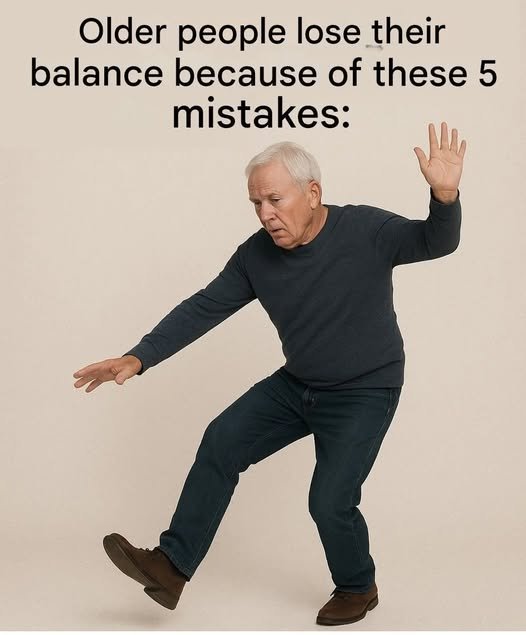
5 Common Mistakes That Can Cause Older Adults to Lose Their Balance
Your eyes play an enormous role in maintaining balance.
Blurred vision, difficulty seeing obstacles, or an outdated glasses prescription can make it harder to navigate safely.
The CDC recommends having vision checked and making sure eyeglasses are up to date as part of fall prevention. (CDC Stacks)
Don’t Ignore Changes Such As:
Blurry vision
Difficulty seeing at night
Trouble judging steps
New difficulty reading signs
Increased sensitivity to glare
Regular eye examinations can help identify problems before they contribute to a fall.
3. Taking Medications Without Reviewing Their Side Effects
This is an especially important one.
Some medications can cause side effects such as dizziness, sleepiness, blurred vision, confusion, or changes in blood pressure, all of which can increase the risk of falling. (CDC Stacks)
Older adults may also take several medications at the same time, making medication reviews particularly important.
What Should You Do?
Don’t stop a prescription medication on your own.
Instead, ask your doctor or pharmacist to review all of your medications, including over-the-counter products and supplements.
They can determine whether any medication or combination of medications could be contributing to dizziness or balance problems.
4. Wearing the Wrong Shoes
Footwear can make a surprising difference.
Shoes that are loose, unstable, poorly fitting, or have inadequate traction may make walking more difficult.
The CDC recommends paying attention to shoe fit, traction, insoles, and heel height when addressing fall risk. (CDC)
Look for Shoes That:
Fit securely
Have good traction
Don’t slip around on the heel
Provide appropriate support
Are comfortable for walking
Be particularly careful on slippery floors, wet surfaces, and uneven ground.
5. Ignoring Hazards Around the Home
You don’t necessarily have to be walking outside to fall.
Everyday objects around the house can create hazards.
Loose rugs, electrical cords, clutter, poor lighting, and slippery surfaces can all make moving around more difficult.
The CDC recommends assessing the home environment and making changes such as improving lighting, removing hazards, and installing appropriate grab bars or railings. (CDC Stacks)
Take a Quick Look Around Your Home
Check for:
✔️ Loose rugs
✔️ Clutter on the floor
✔️ Electrical cords across walkways
✔️ Poor lighting
✔️ Slippery bathroom surfaces
✔️ Missing handrails on stairs
✔️ Objects that are difficult to reach safely
Small changes can make a big difference.
🧠 Balance Problems Shouldn’t Be Ignored
If someone suddenly develops significant dizziness, difficulty walking, weakness, confusion, or a major change in balance, it shouldn’t simply be blamed on getting older.
A healthcare professional can help determine whether an underlying medical issue, medication side effect, vision problem, or mobility issue is contributing.
And if you’ve already experienced a fall, that’s an important reason to discuss fall prevention with your healthcare provider.
💪 The Good News: Balance Can Be Worked On
Getting older doesn’t automatically mean you have to accept worsening balance.
A comprehensive approach can include:
Strength exercises
Balance training
Regular physical activity
Vision checks
Medication reviews
Safer footwear
Home safety improvements
The CDC identifies these types of interventions as important ways to reduce fall risk in older adults. (CDC)
Final Thoughts
Balance is something many people don’t think about until they notice a problem.
But paying attention early can be valuable.
Instead of assuming that occasional unsteadiness is simply “normal aging,” look at the things that can be changed: activity level, muscle strength, medications, vision, footwear, and the home environment.
The goal isn’t to be afraid of falling.
It’s to make everyday movement safer, stronger, and more confident.
👇 How Many of These Mistakes Are You Making?
Do you think weakness, poor footwear, medications, vision, or household hazards is the most overlooked cause of balance problems?
Share your thoughts below—and send this article to an older family member who might find it useful.
To provide the best experiences, we use technologies like cookies to store and/or access device information. Consenting to these technologies will allow us to process data such as browsing behavior or unique IDs on this site. Not consenting or withdrawing consent, may adversely affect certain features and functions.
Functional
Always active
The technical storage or access is strictly necessary for the legitimate purpose of enabling the use of a specific service explicitly requested by the subscriber or user, or for the sole purpose of carrying out the transmission of a communication over an electronic communications network.
Preferences
The technical storage or access is necessary for the legitimate purpose of storing preferences that are not requested by the subscriber or user.
Statistics
The technical storage or access that is used exclusively for statistical purposes.The technical storage or access that is used exclusively for anonymous statistical purposes. Without a subpoena, voluntary compliance on the part of your Internet Service Provider, or additional records from a third party, information stored or retrieved for this purpose alone cannot usually be used to identify you.
Marketing
The technical storage or access is required to create user profiles to send advertising, or to track the user on a website or across several websites for similar marketing purposes.