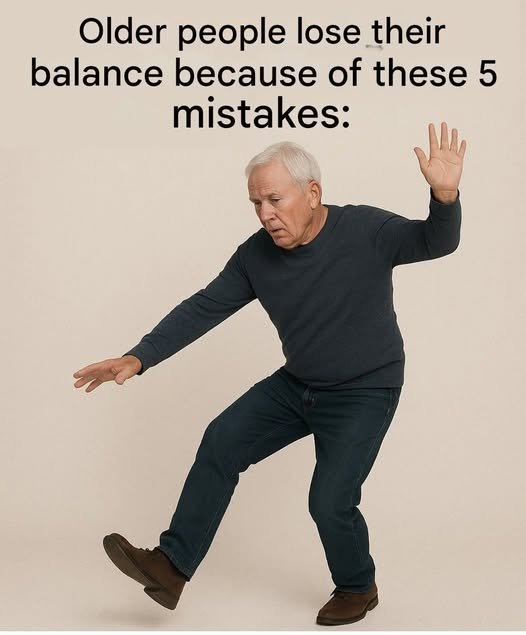
5 Common Mistakes That Can Cause Older Adults to Lose Their Balance
Losing balance as we get older isn’t something that should simply be dismissed as “part of aging.”
Balance can be affected by changes in muscle strength, vision, medications, footwear, walking ability, and the environment around us. The good news is that many fall-risk factors can be identified and improved. The CDC recommends focusing on strength and balance, medication reviews, vision, and home safety. (CDC Stacks)
Here are five common mistakes worth paying attention to.
1. Staying Too Inactive
One of the biggest mistakes is gradually becoming less physically active.
When the legs and core become weaker, everyday movements such as standing up, turning, climbing stairs, or walking over an uneven surface can become more difficult.
Strength and balance exercises can help older adults maintain mobility and reduce fall risk. The CDC specifically recommends exercises targeting strength and balance, including physical therapy or appropriate programs such as Tai Chi. (CDC)
A Better Approach
Try to include safe movement in your daily routine.
Depending on your abilities, this might include:
Walking
Chair-based exercises
Leg-strengthening exercises
Gentle balance exercises
Supervised physical therapy
If you’ve already had a fall or have significant balance problems, ask a healthcare professional about the safest exercises for you.
To provide the best experiences, we use technologies like cookies to store and/or access device information. Consenting to these technologies will allow us to process data such as browsing behavior or unique IDs on this site. Not consenting or withdrawing consent, may adversely affect certain features and functions.
Functional
Always active
The technical storage or access is strictly necessary for the legitimate purpose of enabling the use of a specific service explicitly requested by the subscriber or user, or for the sole purpose of carrying out the transmission of a communication over an electronic communications network.
Preferences
The technical storage or access is necessary for the legitimate purpose of storing preferences that are not requested by the subscriber or user.
Statistics
The technical storage or access that is used exclusively for statistical purposes.The technical storage or access that is used exclusively for anonymous statistical purposes. Without a subpoena, voluntary compliance on the part of your Internet Service Provider, or additional records from a third party, information stored or retrieved for this purpose alone cannot usually be used to identify you.
Marketing
The technical storage or access is required to create user profiles to send advertising, or to track the user on a website or across several websites for similar marketing purposes.