What Is This Thing? The Mysterious Wooden Ford Box Found in an Old Building
The high-voltage output was then used to create the spark at the engine’s spark plug.
In other words, this little wooden box was essentially an early automobile high-voltage transformer and interrupter system.
🔊 Why Were They Called “Buzz Coils”?
The name makes much more sense once you understand how they operated.
The electrical contacts inside the coil rapidly made and broke the circuit while the system was operating.
This produced a characteristic buzzing or vibrating sound.
Unlike a modern electronic ignition system, the mechanism contained moving electrical contacts. The repeated movement was an essential part of generating the high-voltage spark.
It’s one of those fascinating examples of early automotive technology where you could actually hear part of the electrical system working.
🪵 Why Is It Inside a Wooden Box?
The wooden casing wasn’t simply decorative.
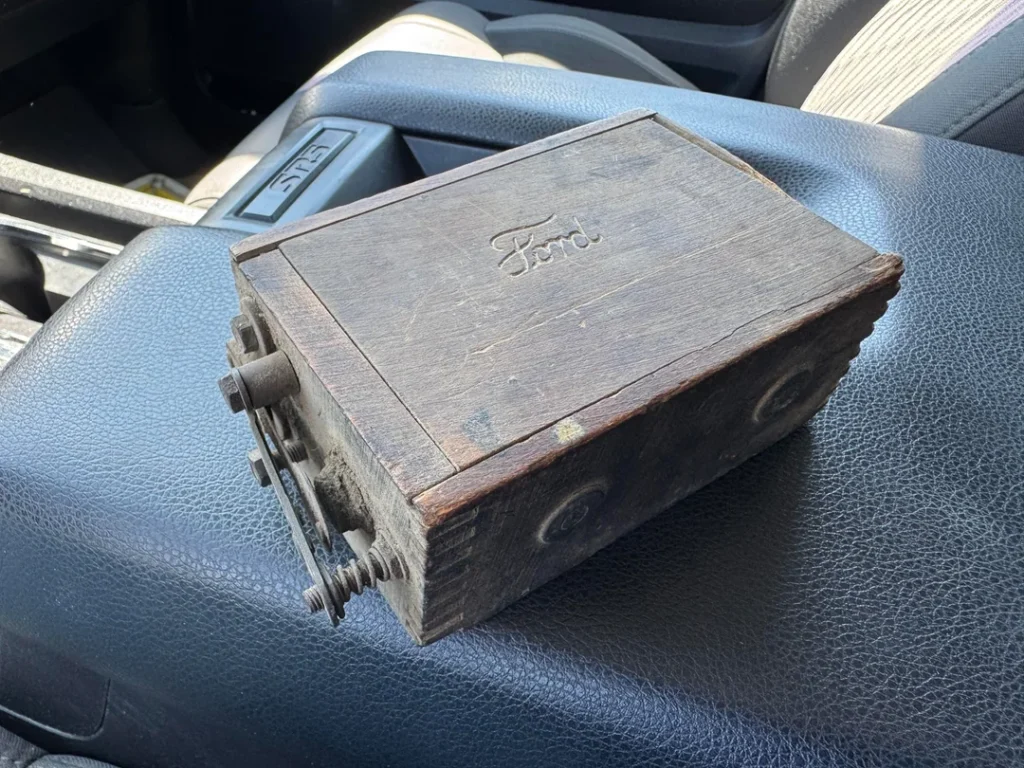
Early Model T ignition coils were commonly enclosed in wooden cases, with electrical connections and contacts mounted around the box.
The wooden construction was practical for the technology of the period and also helped provide insulation and physical protection for the components inside.
The Science Museum Group has an original 1923 Ford Model T ignition coil in its collection and describes it as a coil contained in a wooden box with make-and-break contacts and electrical connections. (Science Museum Group Collection)
🔧 There Were Four of Them in a Model T
One of the most interesting things about this discovery is that a single Model T didn’t use just one of these coils.
It used four, with one coil assigned to each cylinder.
The four coils were mounted together in the vehicle, allowing the ignition system to fire each cylinder at the appropriate time. (Wikipédia)
This is very different from the ignition systems most drivers are familiar with today.
🕰️ A Piece of Early Automotive History
The Model T was revolutionary because it helped make automobile ownership accessible to ordinary people.
But the technology inside these early cars can seem almost primitive compared with modern vehicles.
There were no computerized engine controls, electronic fuel injection systems, or modern coil-on-plug ignition systems.
Instead, engineers relied on mechanical switches, magnets, coils, contacts, and carefully designed electrical circuits.
The little wooden Ford box in the photograph is a perfect example of that era.
🔍 Why Would Someone Find One in an Old Building?
Finding a part like this in an old building isn’t particularly surprising.
Model T cars were extremely common, and their components were repaired, replaced, reused, and sometimes repurposed for other mechanical or electrical applications.
Historical Model T enthusiasts still collect these ignition coils today, and original examples can be found in antique-car collections and parts markets.
There are even documented examples of Model T coils being reused on stationary farm engines and other early machinery. (MTFCA)
🧠 The “Simple” Technology Was Actually Clever
It’s easy to look at the box and wonder how something so simple could have powered an automobile’s ignition.
But the principle behind it was clever.
The coil essentially took relatively low-voltage electrical energy and transformed it into a much higher voltage capable of producing a spark.
Historical technical references describe Model T coils as using primary and secondary windings together with an interrupter mechanism to generate the high-voltage output. (World Radio History)
The technology was basic by today’s standards—but it worked remarkably well for its time.
⚠️ Don’t Try to Power an Antique Coil Yourself
Although the object looks harmless, an ignition coil is an electrical device designed to produce high voltage.
An original coil may also contain components that can retain electrical energy.
If you discover one in an old building, garage, barn, or attic, it’s best to treat it as an antique electrical component rather than experimenting with it.
🏁 The Answer
So, what is this strange wooden Ford box?
It’s most likely a Ford Model T ignition coil, also called a trembler coil or buzz coil.
A Model T used four of these—one for each cylinder—to generate the high-voltage spark required to ignite the engine’s fuel mixture. (Science Museum Group Collection)
What looks like an old wooden box is actually a fascinating piece of early automotive engineering.
🕰️ Imagine Finding This in an Old Barn…
A century ago, this little box could have been sitting inside one of the most famous automobiles ever produced.
Today, it looks mysterious.
But for a Model T mechanic, it was an essential part of getting the engine to come alive.
Would you have recognized this old Ford ignition coil if you found it in an abandoned building? 👇
To provide the best experiences, we use technologies like cookies to store and/or access device information. Consenting to these technologies will allow us to process data such as browsing behavior or unique IDs on this site. Not consenting or withdrawing consent, may adversely affect certain features and functions.
Functional
Always active
The technical storage or access is strictly necessary for the legitimate purpose of enabling the use of a specific service explicitly requested by the subscriber or user, or for the sole purpose of carrying out the transmission of a communication over an electronic communications network.
Preferences
The technical storage or access is necessary for the legitimate purpose of storing preferences that are not requested by the subscriber or user.
Statistics
The technical storage or access that is used exclusively for statistical purposes.The technical storage or access that is used exclusively for anonymous statistical purposes. Without a subpoena, voluntary compliance on the part of your Internet Service Provider, or additional records from a third party, information stored or retrieved for this purpose alone cannot usually be used to identify you.
Marketing
The technical storage or access is required to create user profiles to send advertising, or to track the user on a website or across several websites for similar marketing purposes.