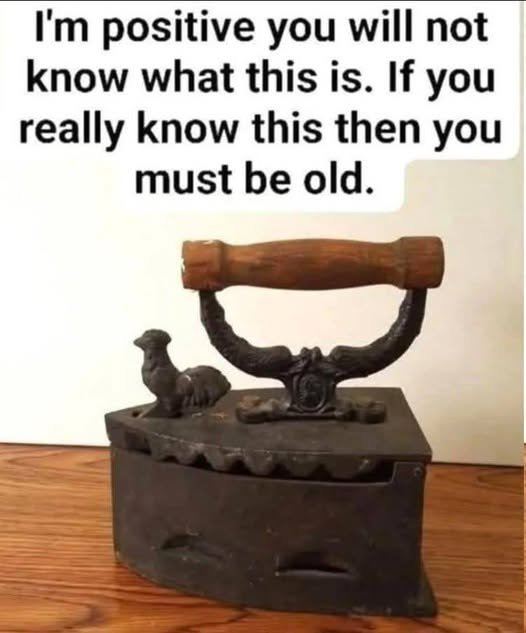
The Strange Iron From Grandma’s Time: Do You Know What This Old Tool Was Used For?
The basic principle was surprisingly simple.
The heavy metal body of the iron was heated, and once it reached the appropriate temperature, it was moved across fabric to smooth wrinkles.
Depending on the design, an iron could be heated directly on a stove, warmed with a removable heated insert, or—like charcoal models—use hot coals inside the body.
This meant ironing was much more hands-on than it is today.
There was no temperature display.
No automatic shutoff.
No electric cord.
And certainly no button that instantly produced heat.
🪵 Why Does It Have a Wooden Handle?
The wooden handle was an important feature.
Metal becomes extremely hot when heated, so holding a bare metal handle would obviously be dangerous.
Wood provided insulation between the user’s hand and the heated body.
Many historical irons therefore incorporated wooden handles or other materials intended to make handling safer.
The handle could also be designed to provide a firm grip while the heavy body was moved back and forth across clothing.
🧱 Why Is the Iron So Heavy?
The weight wasn’t a design mistake.
It was actually part of the technology.
The heavy iron body provided pressure against the fabric while the heated surface helped smooth wrinkles.
Before modern lightweight appliances, the user supplied much of the movement while the weight of the iron did some of the pressing work.
This is one reason traditional “sad irons” could feel surprisingly heavy when you pick one up today.
🔥 What Was Inside a Charcoal Iron?
Some antique irons were designed with a hollow chamber where hot charcoal or embers could be placed.
Air vents helped support combustion, while the heated metal body transferred the heat to the soleplate.
Some charcoal irons also incorporated vents, chimneys, dampers, or decorative components to help control airflow and heat.
That internal design is one of the major differences between a charcoal iron and a simple solid flat iron.
🧺 Not All Antique Irons Worked the Same Way
One fascinating thing about antique irons is that there wasn’t just one design.
There were several different types.
1. Solid Sad Irons
These were essentially solid cast-iron bodies that were heated externally, often on a stove.
They were simple, durable, and extremely common.
2. Box or Slug Irons
These had a hollow chamber designed to hold a separately heated metal insert, sometimes called a slug.
The insert could be heated and then placed inside the iron, allowing the handle and outer body to remain more manageable than a completely exposed heated mass.
3. Charcoal Irons
These contained a chamber for hot charcoal or embers.
Ventilation allowed the charcoal to continue producing heat while the iron was being used.
4. Detachable-Handle Irons
Later designs introduced removable handles and interchangeable iron bodies.
The famous Mrs. Potts design, for example, used a detachable handle so heated iron bodies could be handled more safely and rotated during ironing.
⚠️ Ironing Was Once a Much More Dangerous Job
Imagine having to heat an iron over a stove or with burning charcoal and then carry that extremely hot object over to a pile of clothing.
There was no thermostat telling you whether the surface was too hot.
If the iron was too cool, it wouldn’t press effectively.
If it was too hot, it could scorch or damage fabric.
And because the heat gradually disappeared, people often needed more than one iron available so another could be heating while one was being used.
This made laundry day a much more involved process than most of us experience today.
🏠 Why Did Families Need Several Irons?
Before electric heating became widespread, heat management was part of the job.
A household could keep one iron in use while another was heating.
Historical references to sad irons describe households rotating irons so that one could be reheated while another was being used.
That may sound inefficient today, but at the time it was a practical solution.
The same basic idea appears in many old household technologies: store heat, use it, then replace it with another heated object.
🕰️ When Did Electric Irons Replace Them?
Electric irons gradually changed household ironing by providing a continuous, controllable source of heat.
Instead of repeatedly heating a heavy iron on a stove or using charcoal, the user could plug in an appliance and wait for it to heat.
That was a major convenience.
As electrical appliances became increasingly common, traditional charcoal and stove-heated irons became less important in everyday homes.
Eventually, many of these old tools ended up in attics, barns, kitchens, museums, antique shops, or simply became decorative objects.
🎨 Why Are Some Antique Irons Surprisingly Decorative?
Not every old iron was designed purely for function.
Some historical examples have decorative details, unusual handles, ornate castings, or distinctive shapes.
Collectors today sometimes appreciate these objects not only as household tools but also as examples of historical craftsmanship.
The construction can reveal a lot about the period in which the item was made.
Details such as the casting, handle design, vents, maker’s marks, and construction can help researchers determine what type of iron they are looking at.
🔍 How Can You Tell What Type of Antique Iron You Have?
If you ever discover one in an old house or family collection, don’t immediately assume it’s just a generic clothes iron.
Look carefully for:
A hinged lid
Air vents
A charcoal chamber
A removable insert
A detachable handle
Maker’s marks
Patent dates
Numbers or weight markings
A wooden handle
A matching stand or trivet
These small details can tell you much more about the object.
Collectors and researchers often photograph the top, bottom, sides, and any markings before attempting identification.
💰 Could an Old Iron Be Valuable?
Possibly—but not every antique iron is rare.
Plain cast-iron sad irons are relatively common, while unusual designs, identifiable manufacturers, complete sets, early examples, and well-preserved accessories can be more interesting to collectors.
Condition matters too.
A damaged iron with severe corrosion may be worth far less than a complete example with its original handle, mechanism, or accessories.
So if you find one in an old family collection, don’t sandblast it or aggressively remove the surface finish before researching it.
The marks and original surface can contain valuable information about its history.
🧠 The Most Interesting Part
What makes these old irons fascinating isn’t just their appearance.
It’s the fact that something we now consider a simple household chore once required a completely different technology.
Today, you can plug in an iron, select a temperature, and begin.
Someone using an antique charcoal iron had to think about:
Heat. Fuel. Timing. Weight. Fabric. Safety.
The appliance may look primitive to us, but it was actually a clever solution to a very ordinary problem.
Final Thoughts
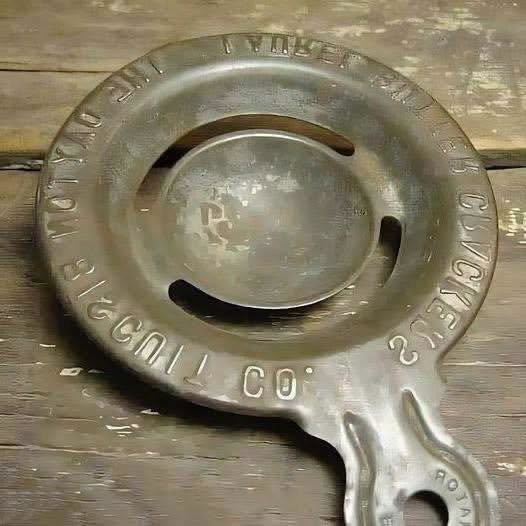
That strange object in the photograph is a reminder of just how much everyday life has changed.
What looks like an oddly shaped piece of heavy metal was once a practical household appliance used to keep clothing neat before modern electric irons became commonplace.
Antique charcoal and box irons are fascinating pieces of domestic history because they show how people solved everyday problems with the materials and technology available to them.
And the next time you see an old metal object in your grandmother’s attic or an antique shop, don’t assume it’s useless.
It might be a piece of everyday technology from a world that has almost completely disappeared.
👇 Did You Recognize It?
Did you know what this was before reading the article?
Have you ever seen one of these old irons in your grandparents’ home—or even used one?
To provide the best experiences, we use technologies like cookies to store and/or access device information. Consenting to these technologies will allow us to process data such as browsing behavior or unique IDs on this site. Not consenting or withdrawing consent, may adversely affect certain features and functions.
Functional
Always active
The technical storage or access is strictly necessary for the legitimate purpose of enabling the use of a specific service explicitly requested by the subscriber or user, or for the sole purpose of carrying out the transmission of a communication over an electronic communications network.
Preferences
The technical storage or access is necessary for the legitimate purpose of storing preferences that are not requested by the subscriber or user.
Statistics
The technical storage or access that is used exclusively for statistical purposes.The technical storage or access that is used exclusively for anonymous statistical purposes. Without a subpoena, voluntary compliance on the part of your Internet Service Provider, or additional records from a third party, information stored or retrieved for this purpose alone cannot usually be used to identify you.
Marketing
The technical storage or access is required to create user profiles to send advertising, or to track the user on a website or across several websites for similar marketing purposes.