The Forgotten Pre-Vacation Ritual: Why People Put an Upside-Down Glass Over the Sink Drain
The idea is simple:
Clean the sink and drain.
Make sure the P-trap contains water.
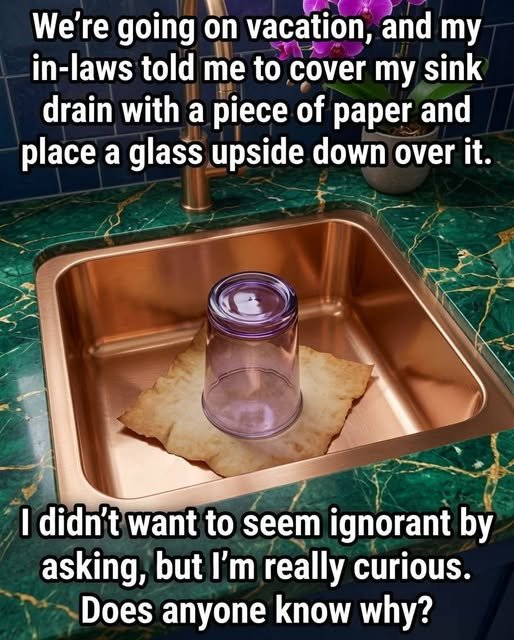
Place a piece of paper or paper towel over the drain.
Put a glass upside down over the paper.
The covering can provide an additional physical barrier over the drain opening.
But there is an important catch:
⚠️ It isn’t a guaranteed airtight seal.
If air can easily pass around the edges of the glass, it won’t completely prevent sewer gases from entering if the P-trap eventually dries out. Several analyses of this viral hack point out that the glass-and-paper method is not a reliable substitute for a proper drain seal. (Weveryday Stories)
So think of it as an optional extra precaution, rather than the main solution.
💧 The Most Important Step Before Leaving
Before going on vacation, run water through the sinks, showers and tubs you don’t regularly use.
This replenishes the water in their P-traps and restores the protective water seal.
For drains that are rarely used—such as basement or utility-room floor drains—this can be particularly important because those traps can dry out more readily. (oatey.ca)
🏠 What About a Short Vacation?
If you’re only leaving for a weekend or a week, you generally don’t need to panic about every sink in your house.
P-traps don’t normally dry out immediately. The risk becomes more relevant with longer periods of inactivity, particularly in hot, dry conditions or with drains that are rarely used. (Weveryday Stories)
For a longer trip, however, taking a few minutes to prepare your drains is a sensible precaution.
🧼 A Better Pre-Vacation Sink Routine
Before locking the door and heading to the airport:
1. Clean the sink
Remove food particles, grease and other residue around the drain.
2. Run fresh water
Run water through the sink for several seconds to refill the P-trap.
3. Check other drains
Don’t forget:
Bathroom sinks
Bathtubs
Showers
Laundry sinks
Floor drains
4. Use a proper drain stopper if available
A snug stopper or purpose-made drain cover provides a more predictable physical barrier than simply balancing a glass over a sheet of paper.
5. Consider the length of your trip
For a short vacation, normal P-trap water seals are generally sufficient. For a prolonged absence, pay more attention to rarely used drains.
❌ One Thing You Shouldn’t Do
Don’t pour random chemicals down your drains simply because you’re leaving the house.
You don’t need harsh chemicals to “disinfect” an empty drain.
The basic goal is much simpler:
Keep the P-trap filled with water and, if desired, use a proper drain cover to slow evaporation and help keep debris or insects out.
🤔 So, Does the Viral Hack Actually Work?
There is some logic behind it—but the internet often exaggerates it.
The real plumbing principle is the water-filled P-trap.
The upside-down glass may provide an additional physical barrier, but unless it forms a proper seal, it shouldn’t be relied upon to stop sewer gases after the trap has dried out. (Weveryday Stories)
In other words:
The water in the P-trap is the real hero. The glass is just extra protection.
🧳 A Simple Habit Before Your Next Vacation
Before you leave:
✔ Clean the sink ✔ Run water through the drain ✔ Check rarely used drains ✔ Use a proper drain stopper if you have one ✔ Make sure your home is prepared for the length of your absence
It’s a small amount of preparation that can help you return to a home that smells the way you left it.
💬 Have you ever heard of the upside-down glass trick?
Did your parents or grandparents have a similar pre-vacation household ritual?
Tell us in the comments! 👇
This article is for general home-maintenance information. If you notice persistent sewer odors after returning home, the problem may involve a dry trap, damaged plumbing, or another issue that should be inspected by a qualified plumber.
To provide the best experiences, we use technologies like cookies to store and/or access device information. Consenting to these technologies will allow us to process data such as browsing behavior or unique IDs on this site. Not consenting or withdrawing consent, may adversely affect certain features and functions.
Functional
Always active
The technical storage or access is strictly necessary for the legitimate purpose of enabling the use of a specific service explicitly requested by the subscriber or user, or for the sole purpose of carrying out the transmission of a communication over an electronic communications network.
Preferences
The technical storage or access is necessary for the legitimate purpose of storing preferences that are not requested by the subscriber or user.
Statistics
The technical storage or access that is used exclusively for statistical purposes.The technical storage or access that is used exclusively for anonymous statistical purposes. Without a subpoena, voluntary compliance on the part of your Internet Service Provider, or additional records from a third party, information stored or retrieved for this purpose alone cannot usually be used to identify you.
Marketing
The technical storage or access is required to create user profiles to send advertising, or to track the user on a website or across several websites for similar marketing purposes.