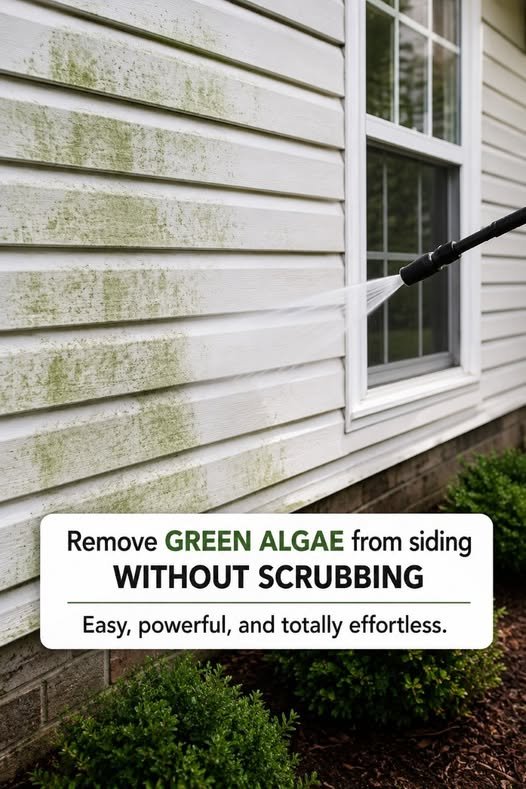
My Neighbor Taught Me This Simple Trick to Remove Green Algae From Siding Without Scrubbing
One of the simplest approaches is to use a cleaner specifically formulated for house siding.
Some commercial siding cleaners are designed to loosen algae, mold and mildew so they can be rinsed away with little or no scrubbing. For example, Rust-Oleum’s Moldex Instant House Wash specifically advertises a spray-on, wait-and-rinse application for algae, mold and mildew stains. (Rust-Oleum)
What You’ll Need
A garden hose or suitable hose-end sprayer
An exterior siding cleaner
Protective gloves
Eye protection
A soft brush for stubborn areas
Clean water
Always check the cleaner’s label and make sure it is suitable for your particular siding material.
Step 1: Protect Your Plants
Before applying any cleaning solution, thoroughly wet nearby grass, flowers and shrubs with clean water.
Cover particularly sensitive plants if necessary.
Many manufacturers recommend rinsing surrounding landscaping before and after exterior cleaning. (Simple Green)
Step 2: Rinse the Siding
Use a regular garden hose to remove loose dirt, dust and debris.
For vinyl siding, avoid directing water upward underneath the panels. Water forced behind the siding can create problems that are much more serious than a dirty exterior.
Step 3: Apply the Cleaner
Apply a siding cleaner according to its label directions.
For example, some products are designed to be applied with a hose-end sprayer, while others are concentrates intended for dilution or pressure-washer application.
A peroxide-based siding cleaner is another option. Simple Green’s Oxy Solve House & Siding Cleaner is specifically formulated for mold, mildew, moss and algae on surfaces including vinyl, aluminum, wood, brick and stucco. (Simple Green)
Step 4: Let the Cleaner Do the Work
This is the part that makes the method so much easier.
Instead of immediately attacking the siding with a brush, allow the product to remain on the surface for the amount of time specified by the manufacturer.
Some no-scrub house-wash products recommend approximately 5–10 minutes of contact time. The important thing is not to let the cleaner dry completely on the siding. (Rust-Oleum Support)
You may notice the green staining gradually loosening or fading.
Step 5: Rinse Thoroughly
Rinse the siding thoroughly with clean water.
For many siding-cleaning systems, rinsing from the top down helps carry loosened dirt and cleaner away from the surface. (Simple Green)
If a few stubborn areas remain, repeat the treatment or use a soft-bristled brush rather than aggressively scrubbing.
⚠️ What About Bleach?
Bleach can be effective against algae and mold on certain exterior surfaces, and some commercial siding cleaners use bleach-based formulas. (Clorox™)
However, bleach requires extra care around plants, landscaping and runoff.
If you’re looking for an alternative, peroxide-based exterior cleaners are available and are specifically marketed for removing algae, mold and mildew without chlorine bleach. (Simple Green)
Never mix bleach with ammonia, acids, vinegar or other household cleaning products.
🚿 Should You Use a Pressure Washer?
A pressure washer can make exterior cleaning faster, but more pressure isn’t necessarily better.
Using excessive pressure or spraying upward can force water behind siding panels.
If you use a pressure washer, follow the siding manufacturer’s recommendations and the cleaning-product instructions. For vinyl siding, low-pressure application is generally preferred, and some manufacturer guidance recommends keeping the nozzle at least 18 inches away and directing the spray downward. (Simple Green)
🌱 How to Keep the Green Growth From Coming Back
Removing the algae is only half the job.
To reduce future growth:
Trim vegetation
Keep bushes and tree branches from constantly touching or shading the siding.
Check your gutters
Overflowing gutters and leaking downspouts can repeatedly wet the same section of wall.
If one side of your home receives very little sunlight, inspect it regularly for new algae or mildew.
Clean periodically
Regular light cleaning is easier than waiting until thick green growth covers the siding.
🏠 The Bottom Line
You don’t necessarily need to spend an entire afternoon scrubbing green algae from your home’s exterior.
A properly selected siding cleaner, adequate contact time and a thorough rinse can do much of the work for you. Some products are specifically designed for spray-on, rinse-off cleaning without scrubbing. (Rust-Oleum Support)
Just remember that the safest method depends on the type and condition of your siding, so check the manufacturer’s cleaning instructions first and test any cleaner on a small inconspicuous area. (Simple Green)
💬 Have you ever had green algae take over your siding?
What worked best for you—a garden hose, a siding cleaner, or a pressure washer?
Share your best cleaning trick in the comments! 👇
This article is for general home-maintenance information. Always follow the label instructions for cleaning products and use appropriate protective equipment.
To provide the best experiences, we use technologies like cookies to store and/or access device information. Consenting to these technologies will allow us to process data such as browsing behavior or unique IDs on this site. Not consenting or withdrawing consent, may adversely affect certain features and functions.
Functional
Always active
The technical storage or access is strictly necessary for the legitimate purpose of enabling the use of a specific service explicitly requested by the subscriber or user, or for the sole purpose of carrying out the transmission of a communication over an electronic communications network.
Preferences
The technical storage or access is necessary for the legitimate purpose of storing preferences that are not requested by the subscriber or user.
Statistics
The technical storage or access that is used exclusively for statistical purposes.The technical storage or access that is used exclusively for anonymous statistical purposes. Without a subpoena, voluntary compliance on the part of your Internet Service Provider, or additional records from a third party, information stored or retrieved for this purpose alone cannot usually be used to identify you.
Marketing
The technical storage or access is required to create user profiles to send advertising, or to track the user on a website or across several websites for similar marketing purposes.