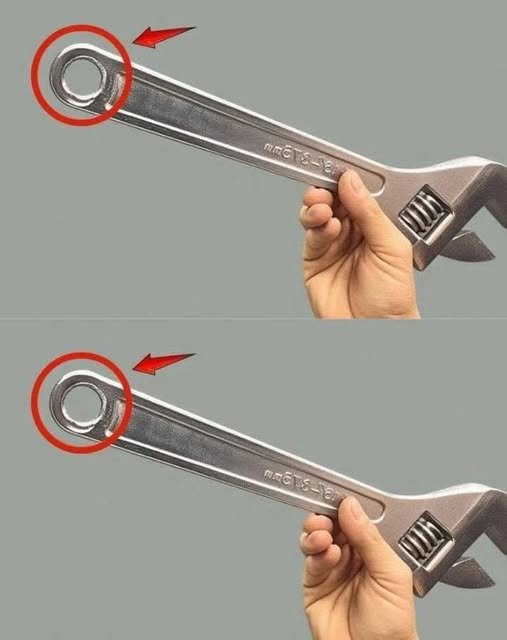
Millions of People Use This Tool Without Knowing the Purpose of This “Secret” Feature
A wrench is heavy and awkward to store compared with smaller tools.
Without a hanging hole, you would generally need to:
Put it inside a toolbox
Place it in a drawer
Lay it on a workbench
Store it in a dedicated tool holder
With the hole, the wrench can simply be hung vertically.
This makes it easier to see and grab when you’re working.
Modern adjustable wrenches from manufacturers such as STANLEY and Klein Tools still specifically describe the handle hole as a feature for hanging, storage, or tethering. (Klein Tools)
🪝 It Can Also Be Used for Tethering
There’s another useful purpose for the same opening.
When working at height, tools can be attached to a tool tether or lanyard to reduce the chance of dropping them.
Klein Tools, for example, describes the large loop hole on its adjustable wrenches as being suitable for tethering or hanging on a peg. (Klein Tools)
This can be particularly useful for workers on ladders, scaffolding, elevated platforms, or other areas where a dropped tool could be dangerous.
🧠 Is It Really a “Secret” Feature?
Not really.
It’s more accurate to call it a commonly overlooked feature.
The hole isn’t hidden, but because most people use adjustable wrenches inside a toolbox, they may never stop to wonder why it exists.
In fact, the design has been around for a very long time. A U.S. patent describing an open-end wrench specifically identifies a hole at the opposite end of the handle as being provided for hanging the wrench when not in use. (Google Patents)
🔩 What Is an Adjustable Wrench Actually Designed For?
The main purpose of the tool is, of course, to tighten and loosen different sizes of fasteners.
An adjustable wrench has:
A fixed jaw
A movable jaw
An adjustment mechanism
A handle
A hanging/tethering hole
The movable jaw can be adjusted using the knurled thumb wheel so that the opening fits the nut or bolt.
Crescent describes adjustable wrenches as tools for gripping, holding, and turning a variety of fasteners. (Crescent Tools)
⚠️ Don’t Use the Hole to Extend the Wrench
You may see people online suggesting that the hole can be used to attach another object and create extra leverage.
That’s not a good idea unless the specific tool is designed for it.
Manufacturers warn against using a hammer or adding an extension to an adjustable wrench because doing so can damage the tool or cause it to fail unexpectedly. (ampcosafetytools.com)
The hole is primarily intended for storage and tethering, not for increasing torque.
🛠️ A Small Feature With a Practical Purpose
This is one of those examples where the simplest explanation is often the correct one.
The hole doesn’t control the jaws.
It doesn’t make the wrench adjustable.
It isn’t a hidden socket.
It’s simply a convenient way to keep the tool organized and, on suitable models, attach a safety tether.
And that’s actually a pretty clever bit of tool design.
👀 Have You Ever Wondered About This?
Most people probably never give that little hole a second thought.
But now you know:
That opening is primarily a hanging and tethering hole. 🔧
The next time you see an adjustable wrench hanging neatly on a workshop wall, you’ll know exactly why that small hole is there.
What did you think the hole was for?
Did you already know its purpose, or did you think it was some kind of hidden feature?
To provide the best experiences, we use technologies like cookies to store and/or access device information. Consenting to these technologies will allow us to process data such as browsing behavior or unique IDs on this site. Not consenting or withdrawing consent, may adversely affect certain features and functions.
Functional
Always active
The technical storage or access is strictly necessary for the legitimate purpose of enabling the use of a specific service explicitly requested by the subscriber or user, or for the sole purpose of carrying out the transmission of a communication over an electronic communications network.
Preferences
The technical storage or access is necessary for the legitimate purpose of storing preferences that are not requested by the subscriber or user.
Statistics
The technical storage or access that is used exclusively for statistical purposes.The technical storage or access that is used exclusively for anonymous statistical purposes. Without a subpoena, voluntary compliance on the part of your Internet Service Provider, or additional records from a third party, information stored or retrieved for this purpose alone cannot usually be used to identify you.
Marketing
The technical storage or access is required to create user profiles to send advertising, or to track the user on a website or across several websites for similar marketing purposes.