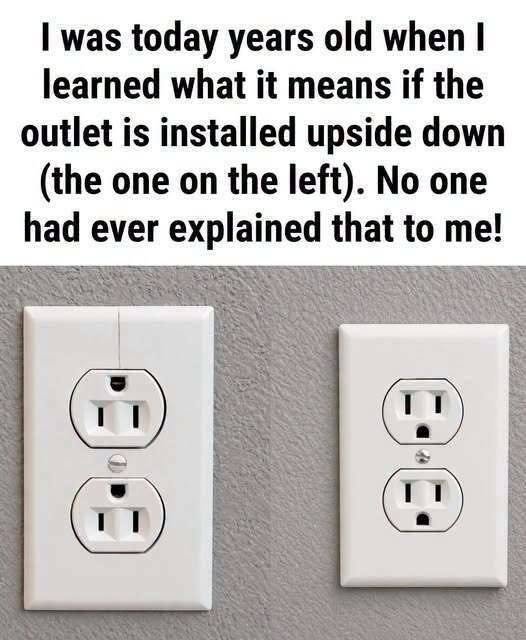
Is Your Electrical Outlet Installed Upside Down? The Real Reason Behind the Different Orientations
🧰 What About Commercial and Industrial Buildings?
This is where things can get more complicated.
Some commercial, industrial, healthcare, or institutional projects may have their own specifications requiring a particular receptacle orientation.
So while the NEC itself doesn’t generally dictate ground-up versus ground-down for ordinary receptacles, a project specification, local requirement, or equipment design may influence the installation. (NEMA Wiring Devices)
That’s why you may see ground-up receptacles throughout one building and ground-down receptacles in another.
🤔 So Which One Is “Correct”?
If you’re looking at a normal vertical wall receptacle:
Ground UP ✅
Ground DOWN ✅
Neither is automatically an incorrect installation simply because of its orientation.
The important things are that the receptacle is properly wired, securely mounted, correctly grounded, and installed according to applicable electrical codes and the manufacturer’s instructions.
Leviton’s installation instructions, for example, emphasize turning off power at the breaker before working on a receptacle and following applicable electrical codes. (Leviton)
🚨 Don’t Flip an Outlet Yourself Just Because of This
If you notice that an outlet in your home has the ground on the “wrong” side, don’t assume it needs to be changed.
And don’t remove the outlet from the wall simply to rotate it unless you know exactly what you’re doing.
Electrical work can expose you to dangerous voltage.
If an outlet is loose, damaged, hot, discolored, sparking, making unusual noises, or showing signs of overheating, have it inspected by a qualified electrician.
🔍 What You Should Actually Be Checking
The orientation of the grounding hole isn’t the main thing to worry about.
Those are much more meaningful warning signs of an electrical problem.
💡 One Interesting Exception
Electrical receptacles aren’t meant to simply be installed in any position imaginable.
For example, the NEC has specific restrictions concerning receptacles installed face-up on countertops and work surfaces, with additional requirements added for certain locations such as under sinks. (Captain Code 2020)
So “orientation doesn’t matter” doesn’t mean an outlet can be installed randomly anywhere.
The installation location and environment still matter.
🏡 Why Do People Think One Direction Is Wrong?
A lot of this confusion comes from the fact that electricians, homeowners, and manufacturers have different conventions.
Some people prefer the ground pin up for perceived safety advantages.
Others prefer ground down because that’s how they’ve always installed residential receptacles.
Manufacturers themselves show receptacles in different orientations, and NEMA specifically states that there was no hidden intended meaning behind diagrams showing the ground pin up. (NEMA Wiring Devices)
Final Answer
That “upside-down” outlet in the picture isn’t necessarily installed incorrectly.
For standard U.S. receptacles, the NEC generally doesn’t require the grounding opening to face either up or down. The choice can depend on functionality, local convention, the plug being used, and project requirements. (NEMA Wiring Devices)
So the next time you see an outlet that looks “backwards,” don’t immediately call the electrician.
It may have been installed that way on purpose. 🔌
👇 What About Your Home?
Look at your outlets and tell us:
🔼 Ground UP 🔽 Ground DOWN
Which orientation do you have throughout your house?
SEO Title: Why Are Some Electrical Outlets Installed Upside Down? The Real Answer Meta Description: Wondering why some electrical outlets have the ground hole on top while others have it on the bottom? Here’s what electrical codes and industry guidance actually say. URL Slug:why-electrical-outlets-installed-upside-down Primary Keyword: electrical outlet upside down Secondary Keywords: outlet ground up or down, electrical outlet orientation, upside down outlet meaning, ground pin up, ground pin down
To provide the best experiences, we use technologies like cookies to store and/or access device information. Consenting to these technologies will allow us to process data such as browsing behavior or unique IDs on this site. Not consenting or withdrawing consent, may adversely affect certain features and functions.
Functional
Always active
The technical storage or access is strictly necessary for the legitimate purpose of enabling the use of a specific service explicitly requested by the subscriber or user, or for the sole purpose of carrying out the transmission of a communication over an electronic communications network.
Preferences
The technical storage or access is necessary for the legitimate purpose of storing preferences that are not requested by the subscriber or user.
Statistics
The technical storage or access that is used exclusively for statistical purposes.The technical storage or access that is used exclusively for anonymous statistical purposes. Without a subpoena, voluntary compliance on the part of your Internet Service Provider, or additional records from a third party, information stored or retrieved for this purpose alone cannot usually be used to identify you.
Marketing
The technical storage or access is required to create user profiles to send advertising, or to track the user on a website or across several websites for similar marketing purposes.