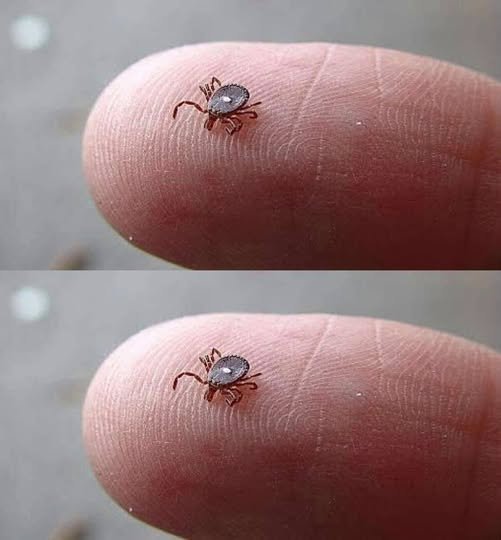
Finding a tiny crawling tick on a child after a walk in the woods can be alarming—especially when it has a distinctive white or silvery mark on its back.
At first glance, the insect in the photo certainly looks like a tick. And that unusual white marking is an important clue.
🕷️ Is It a Lone Star Tick?
Based on the appearance in the photograph, it looks consistent with an adult female lone star tick (Amblyomma americanum), particularly because of the characteristic pale spot on the back.
The CDC describes the adult female lone star tick as having a conspicuous white or silvery “lone star” marking on the rear portion of its back. (CDC)
However, a photograph alone cannot confirm the species with certainty, especially without knowing where the tick was found.
The lone star tick is found mainly across the eastern and southeastern United States, with its range extending into other areas. (CDC Stacks)
⚠️ Should You Be Worried?
Don’t panic—but a tick found on a child should be taken seriously.
Lone star ticks can transmit several diseases, including ehrlichiosis and tularemia. They are also associated with southern tick-associated rash illness (STARI). (CDC Stacks)
Importantly, the presence of a white spot does not mean that the tick is infected.
Also, not every tick bite results in illness.
The most important thing is to remove an attached tick promptly and monitor the child afterward.
🧤 What Should You Do If the Tick Is Still Attached?
If the tick is attached to the skin, don’t cover it with oil, petroleum jelly, nail polish or other substances.
Instead:
Use fine-tipped tweezers.
Grasp the tick as close to the skin as possible.
Pull upward slowly with steady, even pressure.
Avoid twisting or jerking.
Clean the bite area and your hands with soap and water or rubbing alcohol.
The CDC recommends removing attached ticks as soon as possible rather than waiting. (CDC)
If you still have the tick, placing it in a sealed container or other appropriate container can allow a healthcare professional to identify it if necessary. (CDC)
🔍 Check Your Child Carefully
Finding one tick means it’s worth doing a thorough tick check.
Look carefully around:
The scalp and hair
Behind the ears
Neck
Armpits
Waist
Belly button
Behind the knees
Between the legs
Other areas where skin folds occur
The CDC recommends checking children carefully after outdoor activities in areas where ticks are present. (CDC)
Also check clothing, backpacks and pets because ticks can be carried indoors.
To provide the best experiences, we use technologies like cookies to store and/or access device information. Consenting to these technologies will allow us to process data such as browsing behavior or unique IDs on this site. Not consenting or withdrawing consent, may adversely affect certain features and functions.
Functional
Always active
The technical storage or access is strictly necessary for the legitimate purpose of enabling the use of a specific service explicitly requested by the subscriber or user, or for the sole purpose of carrying out the transmission of a communication over an electronic communications network.
Preferences
The technical storage or access is necessary for the legitimate purpose of storing preferences that are not requested by the subscriber or user.
Statistics
The technical storage or access that is used exclusively for statistical purposes.The technical storage or access that is used exclusively for anonymous statistical purposes. Without a subpoena, voluntary compliance on the part of your Internet Service Provider, or additional records from a third party, information stored or retrieved for this purpose alone cannot usually be used to identify you.
Marketing
The technical storage or access is required to create user profiles to send advertising, or to track the user on a website or across several websites for similar marketing purposes.