Seniors: Should You Add a Mineral to Your Water for Better Circulation?
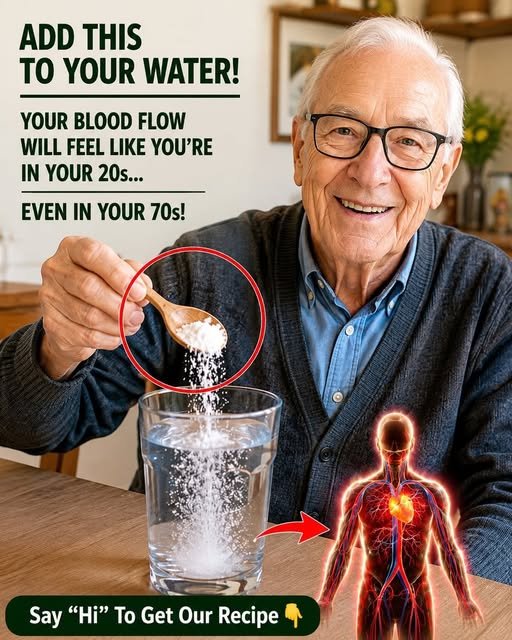
A popular social-media claim suggests that older adults should stop drinking plain water and add a mineral to their glass to make their blood circulation feel “like it did in their 20s.”
The idea sounds simple, but there is an important distinction between staying properly hydrated and adding extra minerals or salt to water.
There is no proven drink that can restore circulation to that of a younger person overnight. However, hydration, regular physical activity, a heart-healthy diet and good blood-pressure control all play important roles in cardiovascular health.
💧 Does Adding Salt to Water Improve Circulation?
If the mineral shown in the image is salt or sodium, adding extra salt to drinking water is not generally recommended as a way to improve circulation.
Sodium is an essential mineral. The body needs some sodium to help regulate fluid balance and support normal nerve and muscle function. But consuming too much sodium can increase blood pressure. (www.heart.org)
The American Heart Association recommends that most adults consume no more than 2,300 mg of sodium per day, with an ideal goal of no more than 1,500 mg for most adults, particularly those with high blood pressure. (www.heart.org)
So, adding spoonfuls of salt to water simply because a viral post promises better circulation could actually be counterproductive.
🫀 Why Is Blood Circulation Important?
Your circulatory system continuously delivers oxygen and nutrients throughout your body while carrying carbon dioxide and other waste products away.
As we age, maintaining cardiovascular health becomes increasingly important.
Rather than looking for a single ingredient, several lifestyle habits can support healthy circulation and cardiovascular function.
These include:
🚶 Regular physical activity
🥗 Eating a balanced diet
💧 Maintaining adequate hydration
🩺 Monitoring blood pressure
🚭 Avoiding tobacco
😴 Getting sufficient sleep
⚖️ Maintaining a healthy weight
The American Heart Association’s current blood-pressure guidance emphasizes lifestyle measures such as healthy eating, reducing sodium, increasing appropriate dietary potassium, physical activity, stress management and limiting alcohol. (professional.heart.org)
🚶 Walking May Be More Useful Than a “Magic” Drink
One of the simplest habits for supporting cardiovascular health is regular physical activity.
Walking is accessible to many older adults and can be incorporated into everyday life.
You don’t necessarily need an intense workout. A regular walk, appropriate to your fitness and health status, can be a much more meaningful long-term habit than adding an unneeded ingredient to your water.
If you have not exercised for a long time or have a medical condition, talk with your healthcare professional about an appropriate activity level.
🥗 Your Diet Matters Too
A heart-healthy eating pattern can have a much greater impact on cardiovascular health than a special drink.
The DASH eating pattern, for example, emphasizes vegetables, fruits, whole grains, legumes, nuts and seeds, while encouraging lower sodium intake. (www.heart.org)
Good everyday choices can include:
🥬 Vegetables
Leafy greens, tomatoes, peppers, broccoli and other vegetables provide important nutrients and fiber.
To provide the best experiences, we use technologies like cookies to store and/or access device information. Consenting to these technologies will allow us to process data such as browsing behavior or unique IDs on this site. Not consenting or withdrawing consent, may adversely affect certain features and functions.
Functional
Always active
The technical storage or access is strictly necessary for the legitimate purpose of enabling the use of a specific service explicitly requested by the subscriber or user, or for the sole purpose of carrying out the transmission of a communication over an electronic communications network.
Preferences
The technical storage or access is necessary for the legitimate purpose of storing preferences that are not requested by the subscriber or user.
Statistics
The technical storage or access that is used exclusively for statistical purposes.The technical storage or access that is used exclusively for anonymous statistical purposes. Without a subpoena, voluntary compliance on the part of your Internet Service Provider, or additional records from a third party, information stored or retrieved for this purpose alone cannot usually be used to identify you.
Marketing
The technical storage or access is required to create user profiles to send advertising, or to track the user on a website or across several websites for similar marketing purposes.