Been Out of the Loop on Keyless Cars? 10 Things Every Driver Should Know
Keyless cars have made driving more convenient than ever.
You can unlock the doors without taking the key out of your pocket, start the engine with a button, and sometimes even open the trunk simply by approaching the vehicle.
But if you’ve only recently started using a keyless car, there are several things that may not be obvious.
And one of the most important involves something almost every driver will eventually face:
What happens when the key-fob battery dies?
Let’s look at 10 useful things every keyless-car owner should know.
1. Your Car Doesn’t Need the Key Fob Battery to Start in an Emergency
A dead key-fob battery doesn’t necessarily mean you’re stranded.
Many modern keyless vehicles have a backup system that can recognize a passive transponder inside the fob even when the fob’s main battery is depleted.
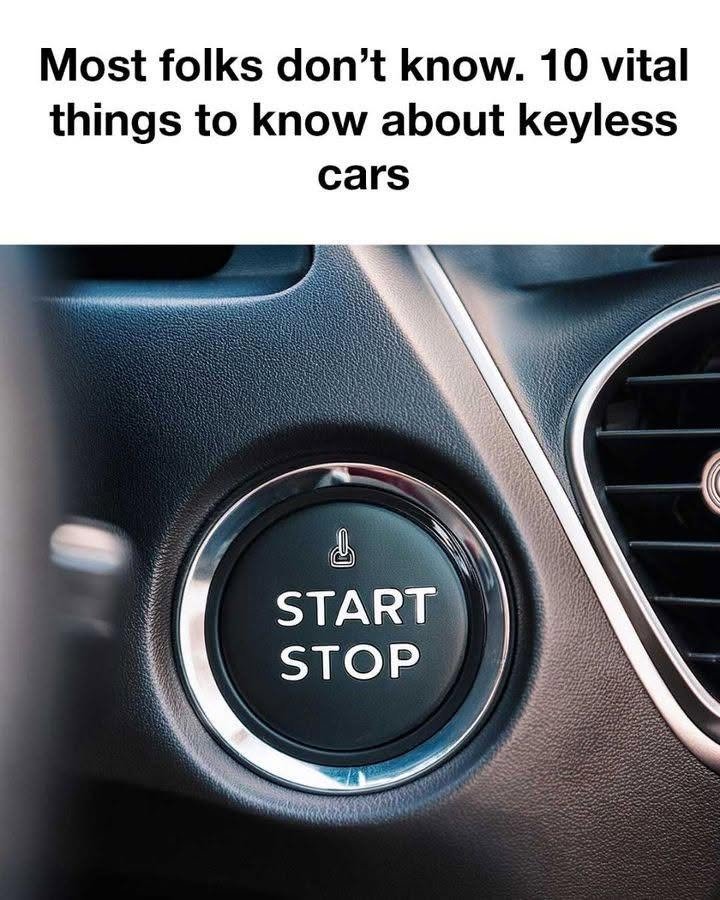
Depending on the vehicle, you may need to hold the fob directly against the START/STOP button, place it in a designated slot, or position it near a specific area of the steering column or center console. (AAA International Relations)
The exact procedure varies by make and model, so your owner’s manual is the best source for the correct emergency-start location.
2. Your Key Fob May Contain a Hidden Physical Key
Many smart keys contain a small mechanical key blade hidden inside the fob.
If the fob battery dies and the remote buttons no longer unlock the vehicle, that physical key can often be used to unlock the driver’s door manually. Ford, for example, documents this type of emergency key inside its intelligent-access fobs. (Ford UK)
It’s worth knowing where that hidden key is before you actually need it.
3. Don’t Assume Every Keyless Car Works the Same Way
This is one of the biggest misconceptions.
There isn’t one universal procedure for every push-button vehicle.
To provide the best experiences, we use technologies like cookies to store and/or access device information. Consenting to these technologies will allow us to process data such as browsing behavior or unique IDs on this site. Not consenting or withdrawing consent, may adversely affect certain features and functions.
Functional
Always active
The technical storage or access is strictly necessary for the legitimate purpose of enabling the use of a specific service explicitly requested by the subscriber or user, or for the sole purpose of carrying out the transmission of a communication over an electronic communications network.
Preferences
The technical storage or access is necessary for the legitimate purpose of storing preferences that are not requested by the subscriber or user.
Statistics
The technical storage or access that is used exclusively for statistical purposes.The technical storage or access that is used exclusively for anonymous statistical purposes. Without a subpoena, voluntary compliance on the part of your Internet Service Provider, or additional records from a third party, information stored or retrieved for this purpose alone cannot usually be used to identify you.
Marketing
The technical storage or access is required to create user profiles to send advertising, or to track the user on a website or across several websites for similar marketing purposes.