Baking Soda for Dark Spots and Wrinkles: What You Should Know
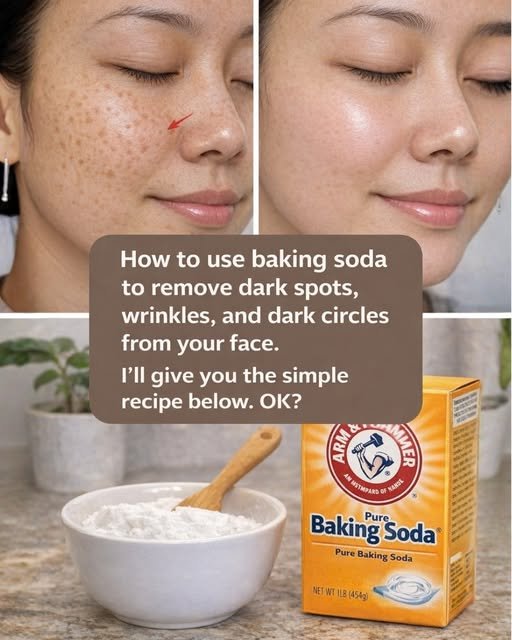
Baking soda is a common household ingredient that often appears in DIY beauty recipes. Viral posts sometimes claim that mixing baking soda into a homemade treatment can remove dark spots, wrinkles, and dark circles and make the skin look dramatically brighter.
However, there is no good evidence that baking soda can safely remove wrinkles or pigmentation from the face. In fact, using harsh or irritating ingredients on the skin can sometimes make pigmentation worse.
Can Baking Soda Remove Dark Spots?
Not reliably.
Dark spots can have many causes, including sun exposure, acne, skin irritation, hormonal changes, and certain medications. Treatment depends on the underlying cause. (Académie Américaine de Dermatologie)
Dermatologists specifically recommend using gentle skin-care products, because irritation itself can contribute to the development of dark spots, particularly in darker skin tones. (Académie Américaine de Dermatologie)
For this reason, applying abrasive homemade baking-soda pastes to the face isn’t a good approach to treating pigmentation.
What About Wrinkles?
Baking soda does not have a proven anti-aging effect.
Wrinkles are associated with natural aging, sun exposure, and changes in the skin’s collagen and elasticity. A baking-soda mask cannot reverse these changes.
A better long-term approach is protecting the skin from sunlight and using evidence-based skin-care products.
What About Dark Circles?
Dark circles can have several causes, including genetics, pigmentation, visible blood vessels, allergies, lack of sleep, and changes around the eyes with age.
Because the skin around the eyes is particularly delicate, avoid applying baking soda or other harsh DIY mixtures close to the eyes.
A Safer Simple Routine for Dark Spots
Instead of a baking-soda mask, consider a gentle routine.
Morning
Wash your face with a gentle cleanser.
Apply a suitable moisturizer.
Apply a broad-spectrum SPF 30 or higher sunscreen.
Sun protection is one of the most important steps for preventing dark spots from becoming darker and helping existing pigmentation fade. (Académie Américaine de Dermatologie)
Evening
Cleanse gently.
Apply a moisturizer.
If appropriate for your skin, consider a product containing an ingredient such as vitamin C, azelaic acid, glycolic acid, kojic acid, or a retinoid. Dermatologists use these ingredients to help fade hyperpigmentation. (Académie Américaine de Dermatologie)
Introduce only one active ingredient at a time and stop if your skin becomes irritated.
Why Sunscreen Matters So Much
Sun exposure can stimulate the production of pigment and make existing dark spots more noticeable.
For people dealing with hyperpigmentation, the American Academy of Dermatology recommends broad-spectrum, water-resistant SPF 30+ sunscreen. Tinted sunscreen containing iron oxide can provide additional protection against visible light, which can worsen hyperpigmentation. (Académie Américaine de Dermatologie)
Be Careful With DIY Skin Treatments
“Natural” doesn’t automatically mean “gentle.”
If a homemade treatment causes burning, stinging, redness, or irritation, stop using it. Skin irritation can actually contribute to additional pigmentation. (Académie Américaine de Dermatologie)
Avoid experimenting with strong household chemicals or abrasive mixtures on your face.
When Should You See a Dermatologist?
Consider seeing a dermatologist if:
Dark spots keep appearing.
Pigmentation suddenly changes.
A spot becomes irregular or unusual.
Home treatments aren’t helping.
You have persistent irritation.
You’re unsure what is causing the discoloration.
A dermatologist can determine whether you’re dealing with melasma, post-inflammatory hyperpigmentation, age spots, or another skin condition and recommend an appropriate treatment. (Académie Américaine de Dermatologie)
Final Thoughts
Baking soda may be useful around the house, but it isn’t a proven treatment for wrinkles, dark circles, or facial dark spots.
For healthier-looking skin, focus on gentle skin care, daily sun protection, and evidence-based ingredients. And if pigmentation is persistent or worsening, getting the correct diagnosis is much more useful than trying another viral DIY recipe.
Have you ever tried a homemade skincare remedy? 🌿✨ Tell us what you used in the comments!
To provide the best experiences, we use technologies like cookies to store and/or access device information. Consenting to these technologies will allow us to process data such as browsing behavior or unique IDs on this site. Not consenting or withdrawing consent, may adversely affect certain features and functions.
Functional
Always active
The technical storage or access is strictly necessary for the legitimate purpose of enabling the use of a specific service explicitly requested by the subscriber or user, or for the sole purpose of carrying out the transmission of a communication over an electronic communications network.
Preferences
The technical storage or access is necessary for the legitimate purpose of storing preferences that are not requested by the subscriber or user.
Statistics
The technical storage or access that is used exclusively for statistical purposes.The technical storage or access that is used exclusively for anonymous statistical purposes. Without a subpoena, voluntary compliance on the part of your Internet Service Provider, or additional records from a third party, information stored or retrieved for this purpose alone cannot usually be used to identify you.
Marketing
The technical storage or access is required to create user profiles to send advertising, or to track the user on a website or across several websites for similar marketing purposes.