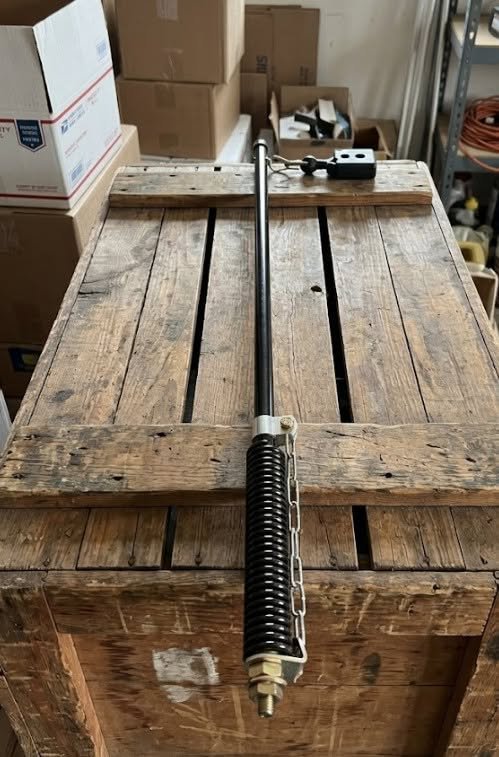
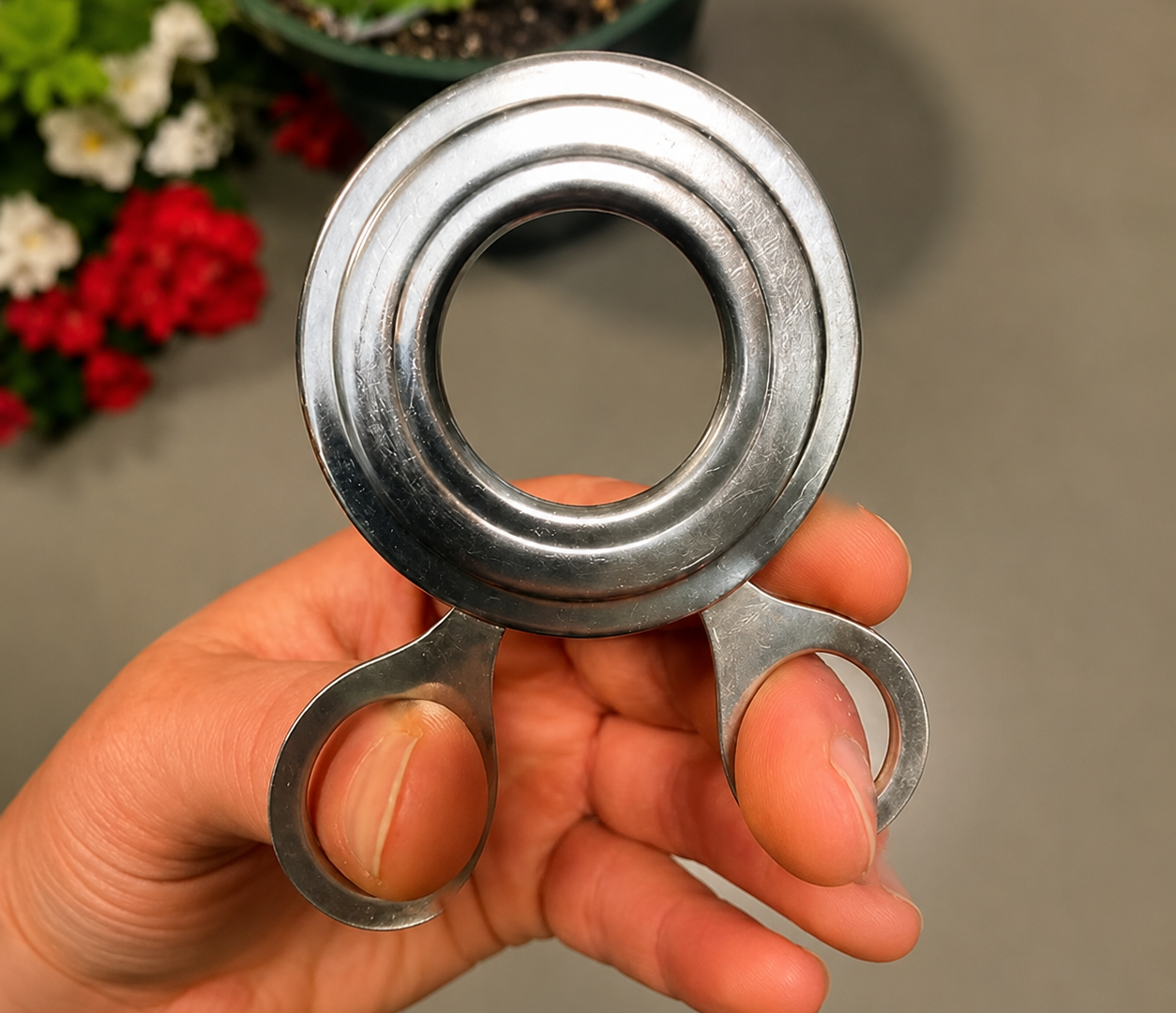
The small chain is one of the most interesting clues.
Chains are often used as a simple way of operating, securing, or limiting the movement of a spring-loaded mechanism.
Historical and mechanical door systems, for example, have used a chain connected to a spring-loaded strike so that pulling the chain releases the mechanism. A U.S. patent describing a barn-door system specifically illustrates a spring-loaded strike connected to a chain for releasing the door latch. (Justia Patents)
That doesn’t prove this particular object came from the same system, but it demonstrates why a spring-and-chain combination appears in mechanical door hardware.
🚪 Could It Be Related to a Gate or Door?
Very possibly.
Spring-loaded rods are widely used in gate hardware.
Modern examples include spring-loaded drop rods and cane bolts, which secure gates and can also be used with barns, sheds, stables, and garage doors. (SecureFix Direct Ltd)
The general principle is straightforward:
The rod moves into position.
The spring keeps pressure on the mechanism.
The gate or door remains secured.
Pulling or releasing the mechanism allows the rod to move.
Older hardware can look much more complicated than modern versions because manufacturers often built mechanisms from individual steel components rather than compact assemblies.
🏚️ Why Would Someone Keep a Part Like This?
The photograph gives another clue: the object appears to be sitting among workshop and storage equipment.
It may have been removed from a larger mechanical assembly during a repair or renovation.
That’s actually how many mystery tools end up being discovered.
Someone replaces a gate, door, piece of machinery, or agricultural equipment, keeps the old hardware “just in case,” and years later nobody remembers what it belonged to.
🔩 The Threaded End Is Important
The threaded section at the end of the rod allows the spring assembly to be adjusted or secured with nuts.
That kind of arrangement is useful when the amount of spring compression needs to be controlled.
By changing the position of the nuts, the installer can alter the spring’s working position.
This is common in mechanical systems where spring tension needs to be adjusted rather than permanently fixed.
🧰 It Isn’t Just a Simple Spring
One reason this object looks so unusual is that several mechanical functions have been combined into one assembly.
You can identify several basic components:
Long steel rod — provides the main movement
Compression spring — provides restoring force
Threaded section — allows adjustment and fastening
Metal brackets — hold the assembly together
Chain — can provide an operating or retaining connection
Nuts and washers — secure and adjust the mechanism
When put together, these components form a controlled mechanical system rather than a standalone hand tool.
🕰️ Why Old Mechanical Hardware Looks So Different
Older machinery often relied on simple mechanical principles rather than electronics.
A designer could accomplish a surprising amount with:
a rod + spring + lever + chain.
There was no need for a sensor, motor, or computer.
The spring automatically supplied force, while the rod transmitted movement.
This approach remains useful today because it is inexpensive, durable, and easy to maintain.
⚠️ Don’t Compress the Spring Just to Test It
If you find an old mechanism like this, don’t try to force the spring by hand.
Large compression springs can store considerable mechanical energy.
If a spring, retaining plate, or threaded component suddenly fails, parts can move unexpectedly.
Before attempting to disassemble an unknown spring mechanism, it’s better to determine what equipment it came from and whether the spring is under load.
🔎 How to Identify the Exact Part
If you have this object in your garage or workshop and want to determine exactly what it is, take photographs of:
1. Both ends of the rod
The shape of the ends can reveal how it was mounted.
2. The spring assembly
Measure its length, diameter, and number of coils.
3. The chain
The length and attachment point can provide an important clue.
4. Any markings
Look for manufacturer names, numbers, stamped letters, or patent information.
5. The surrounding hardware
If you found it near a gate, barn door, trailer, machine, or other equipment, photograph that equipment too.
That additional context can make identification dramatically easier.
🤔 So What Is It Really?
The safest identification from this photograph is that it is a spring-loaded mechanical rod assembly, most likely associated with a door, gate, or other mechanical equipment.
The exact application cannot be confirmed confidently from the photograph alone.
And that’s an important distinction when identifying mystery objects online.
It’s tempting to give every strange object a very specific name, but without seeing how the mechanism was installed—or finding a matching manufacturer’s diagram—there can be several possible applications.
Final Thoughts
This strange-looking object is a great example of how much engineering can be hidden inside a few simple pieces of metal.
A long rod, a compression spring, a chain, and a few threaded components may look like random workshop parts when they’re lying on a table.
But once installed in the right mechanism, they can provide controlled movement, tension, and automatic return force.
If you found this object without knowing its history, what would your first guess have been?
A gate mechanism, door hardware, farm equipment, or something completely different?
To provide the best experiences, we use technologies like cookies to store and/or access device information. Consenting to these technologies will allow us to process data such as browsing behavior or unique IDs on this site. Not consenting or withdrawing consent, may adversely affect certain features and functions.
Functional
Always active
The technical storage or access is strictly necessary for the legitimate purpose of enabling the use of a specific service explicitly requested by the subscriber or user, or for the sole purpose of carrying out the transmission of a communication over an electronic communications network.
Preferences
The technical storage or access is necessary for the legitimate purpose of storing preferences that are not requested by the subscriber or user.
Statistics
The technical storage or access that is used exclusively for statistical purposes.The technical storage or access that is used exclusively for anonymous statistical purposes. Without a subpoena, voluntary compliance on the part of your Internet Service Provider, or additional records from a third party, information stored or retrieved for this purpose alone cannot usually be used to identify you.
Marketing
The technical storage or access is required to create user profiles to send advertising, or to track the user on a website or across several websites for similar marketing purposes.