How to Choose a Sweet Watermelon at the Market: Simple Tricks That Actually Help

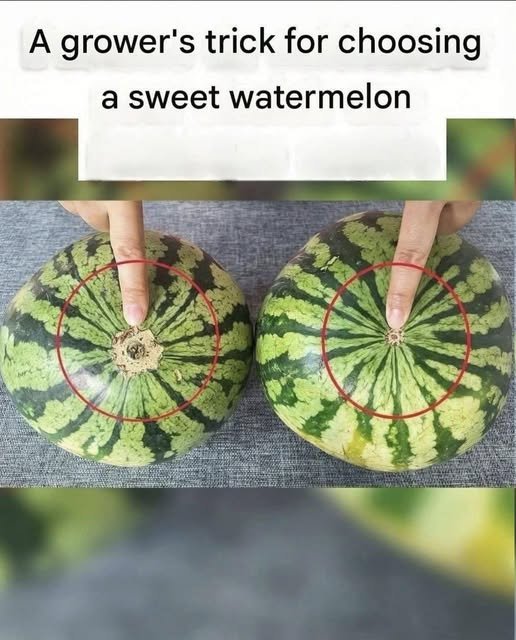
🌼 3. Examine the Blossom End

The opposite end from the stem is known as the blossom end.

Some watermelon-selection guides suggest that a smaller, more compact blossom scar can be associated with certain desirable characteristics.

However, this isn’t a scientifically reliable way to predict sweetness by itself.

Use it as one clue rather than a guarantee.

🟡 4. Look for a Yellowish Field Spot

If you’re standing at the market and have several watermelons to choose from, turn them over carefully and look underneath.

A good field spot can range from creamy yellow to a deeper yellow.

The exact shade isn’t a perfect indicator of sugar content, but it can provide useful information about how the fruit developed.

A completely white or very pale area may suggest less time spent ripening on the ground.

⚖️ 5. Choose a Watermelon That Feels Heavy

This is one of the easiest tricks to use.

Pick up two watermelons that appear to be about the same size.

Choose the one that feels heavier for its size.

Watermelon contains a large amount of water, so a heavy melon can be a good sign that it is well hydrated and juicy.

Of course, weight doesn’t guarantee sweetness—but it’s a useful clue when combined with the other signs.

👊 6. Try the Tap Test Carefully

You’ve probably heard people knocking on watermelons at the grocery store.

The idea is that a ripe watermelon should produce a relatively deep, resonant sound.

An underripe or overripe melon may sound different.

However, the tapping method is subjective and takes practice.

If you’re not experienced at judging watermelons by sound, don’t rely on this method alone.

Use it as an additional clue rather than a scientific test.

🌿 7. Check the Stem

If part of the stem is still visible, take a look at it.

A dry, brownish stem can indicate that the watermelon has reached maturity.

A very green stem may indicate that the fruit was harvested relatively early.

Again, this isn’t a guarantee because watermelons can be harvested and handled in different ways.

But when combined with other signs, the stem can provide useful information.

🍉 8. Look for a Firm, Even Surface

The watermelon should feel firm when you gently press it.

Avoid fruit with:

  • Very soft spots
  • Deep bruises
  • Cracks
  • Cuts
  • Leaking liquid
  • Large sunken areas
  • Signs of mold

A few harmless surface marks aren’t necessarily a problem.

Watermelons can develop scratches and imperfections while growing or during transportation.

The important thing is to distinguish normal cosmetic marks from signs of damage or deterioration.

📏 9. Don’t Automatically Choose the Biggest One

Bigger doesn’t always mean sweeter.

A giant watermelon can be delicious, but size alone doesn’t tell you how much sugar the fruit contains.

Instead, compare watermelons of similar size and look for the combination of:

good field spot + heavy feel + firm skin + healthy appearance.

That’s a much better strategy than simply grabbing the largest melon in the pile.

🧠 What About the “Male” and “Female” Watermelon Myth?

You may have seen social-media posts claiming that watermelons come in “male” and “female” versions.

These posts often say that one shape produces sweeter fruit while another produces more watery fruit.

That’s not botanically accurate.

Watermelons don’t have separate “male” and “female” fruits.

The plant has flowers with male and female reproductive structures, but the individual watermelon isn’t classified as a male or female fruit.

So don’t reject a watermelon simply because of its shape.

🍬 Can You Really Tell How Sweet It Will Be From the Outside?

Not perfectly.

Sugar content depends on several factors, including:

  • Variety
  • Growing conditions
  • Weather
  • Irrigation
  • Plant maturity
  • Harvest timing
  • Storage
  • Transportation

That’s why two watermelons that look almost identical can taste noticeably different.

The outside can provide clues, but the only guaranteed way to know the exact sweetness is to measure the fruit after cutting it open.

🌱 Why Harvest Timing Matters

Watermelons are different from some fruits that continue to ripen substantially after harvest.

Once harvested, the fruit doesn’t continue increasing its sugar content in the same way it would while attached to the plant.

That makes harvest maturity particularly important.

A watermelon picked at the right stage has a much better chance of being sweet, juicy, and flavorful.

đź›’ A Quick Market Checklist

Next time you’re shopping for watermelon, don’t overthink it.

Look for:

âś… A yellow or creamy field spot

âś… A watermelon that feels heavy for its size

âś… Firm, intact skin

âś… A dry-looking stem when visible

âś… No soft or damaged areas

âś… A healthy overall appearance

Then, if you’re comfortable doing so, compare the sound of a gentle tap between several melons.

🍉 The Best Strategy: Use Several Clues Together

The biggest mistake is believing that one visual trick can guarantee a sweet watermelon.

It can’t.

Instead, think like this:

Field spot + weight + firmness + appearance + harvest clues = better odds.

Each clue provides a little information.

Together, they give you a much better chance of taking home a delicious watermelon.

🌞 One More Tip: Don’t Forget How You Store It

Once you’ve selected your watermelon, storage also matters.

An intact watermelon can generally be kept at room temperature for a period of time, while a cut watermelon should be refrigerated promptly.

Once you cut it open, keep the pieces covered and refrigerated.

And if the fruit develops an unusual smell, texture, mold, or other signs of spoilage, it’s best not to eat it.

Final Thoughts

Choosing a sweet watermelon doesn’t have to be a guessing game.

The next time you’re standing in front of a pile of watermelons, don’t simply choose the prettiest one.

Turn it over.

Look for a well-developed yellow field spot.

Pick it up.

Choose one that feels heavy for its size.

Check the skin.

Make sure it is firm and free from serious damage.

And remember that popular tricks like looking at the “male” or “female” shape of a watermelon aren’t reliable scientific methods.

There is no foolproof visual test—but by combining several useful clues, you can definitely improve your chances of bringing home a sweet, juicy watermelon. 🍉

👇 What’s Your Watermelon Trick?

Do you check the yellow spot, tap the watermelon, look at the stem, or simply pick the heaviest one?

What’s the best watermelon you’ve ever bought? Tell us your trick in the comments! 🍉👇

Leave a Comment