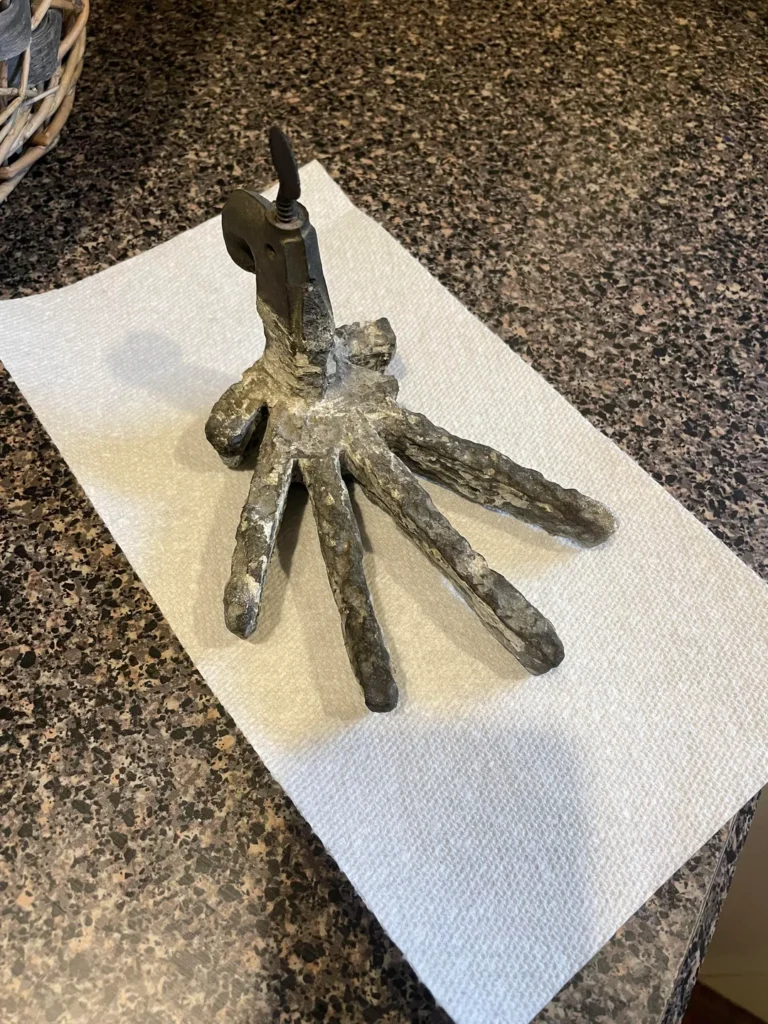
Object Found in the Attic of an Old House: What Is It?
🐟 Why So Many Prongs?
The multiple points were the key to the tool’s design.
A fish or eel could be difficult to catch with a single spear. Multiple closely spaced points increased the likelihood that the animal would be caught when the spear was thrust toward it.
Historical examples include four-prong, five-prong, and six-prong fishing spears, showing just how varied these designs could be. (doczz.net)
🪵 It Was Probably Attached to a Long Pole
The unusual metal section at the top is an important clue.
Fishing gigs were often mounted onto long wooden poles, allowing the user to reach into shallow water without getting into the water themselves.
Some antique examples were specifically designed with fittings for attaching a wooden handle or pole. (Cisco’s Gallery)
Once mounted on a pole, the pronged head could be used from the bank, a boat, or in shallow water.
🌊 Could It Have Been Used for Eels?
Possibly.
Eel spears and eel gigs are particularly well represented among antique fishing tools. Six-prong versions are known, and surviving examples are often described as primitive or hand-forged fishing equipment. (Etsy)
The broad arrangement of the prongs in this photograph makes an eel/fish gig a reasonable identification, although the exact original use cannot be confirmed from the photograph alone.
🕰️ Why Would One Be in an Attic?
If the house was old and located near a river, lake, marsh, or coastal area, an old fishing tool would make perfect sense.
Before modern fishing equipment became inexpensive and widely available, people often made use of sturdy tools that could last for generations.
When the tool was no longer needed, it could easily have ended up in a barn, shed, workshop, basement, or attic—and eventually been forgotten.
🔍 The Mystery Isn’t Completely Solved
There is an important caveat: the photograph alone isn’t enough to establish the exact age or original purpose with certainty.
The object could potentially belong to a related category of old agricultural or fishing tools. Its unusual construction and the absence of a visible complete handle make a definitive identification difficult.
But the combination of multiple forged prongs + a pole-mounting section + its resemblance to documented antique six-prong gigs makes an old fishing/eel gig one of the strongest possibilities. (doczz.net)
🧰 A Forgotten Tool From Another Era
What looks like a strange piece of rusty metal may actually be a reminder of how people once obtained food using simple tools and local resources.
No plastic handles. No modern fishing gear. No complicated machinery.
Just a piece of forged iron attached to a wooden pole—and enough skill to know exactly how to use it.
What Do You Think?
If you found this in the attic of an old house, would you recognize it as an old fishing gig?
Or do you think it was made for something completely different?
To provide the best experiences, we use technologies like cookies to store and/or access device information. Consenting to these technologies will allow us to process data such as browsing behavior or unique IDs on this site. Not consenting or withdrawing consent, may adversely affect certain features and functions.
Functional
Always active
The technical storage or access is strictly necessary for the legitimate purpose of enabling the use of a specific service explicitly requested by the subscriber or user, or for the sole purpose of carrying out the transmission of a communication over an electronic communications network.
Preferences
The technical storage or access is necessary for the legitimate purpose of storing preferences that are not requested by the subscriber or user.
Statistics
The technical storage or access that is used exclusively for statistical purposes.The technical storage or access that is used exclusively for anonymous statistical purposes. Without a subpoena, voluntary compliance on the part of your Internet Service Provider, or additional records from a third party, information stored or retrieved for this purpose alone cannot usually be used to identify you.
Marketing
The technical storage or access is required to create user profiles to send advertising, or to track the user on a website or across several websites for similar marketing purposes.