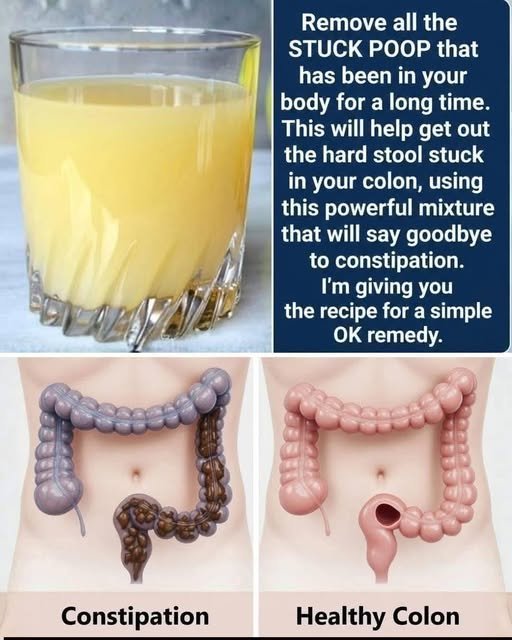
Constipation: How to Relieve It Safely and Naturally
Instructions
Soak the prunes in warm water for about 10 minutes.
Add the pear, prunes, flaxseed, and water to a blender.
Blend until smooth.
Add yogurt if desired.
Drink immediately.
Why Fiber Matters
Fiber can help make stools softer and easier to pass. Adults generally need around 22–34 grams of fiber per day, depending on age and sex. Good sources include whole grains, beans, lentils, fruits, vegetables, and nuts. (Institut national du diabète et des maladies digestives et rénales)
If you’re increasing your fiber intake, do it gradually and drink enough fluids so the fiber can work effectively.
If lifestyle changes aren’t enough, some people may benefit from an over-the-counter laxative. Different types work in different ways, including fiber supplements and osmotic laxatives.
Laxatives should be used according to the product instructions or advice from a healthcare professional. Stimulant laxatives are generally recommended only when constipation is severe or other measures have not worked. (Institut national du diabète et des maladies digestives et rénales)
If you regularly need laxatives to have a bowel movement, talk with a healthcare professional rather than continuing to increase the dose yourself.
Don’t Try to Physically Remove “Stuck Stool” Yourself
Severe constipation can sometimes lead to fecal impaction, where hard stool becomes trapped in the rectum.
Treatment may involve stronger laxatives, suppositories, enemas, or removal by a healthcare professional. Manual removal should not be attempted at home. (nhs.uk)
When Should You See a Doctor?
Speak with a healthcare professional if constipation:
Keeps coming back
Doesn’t improve with treatment
Is accompanied by persistent bloating
Causes abdominal pain
Is associated with unexplained weight loss
Is accompanied by blood in the stool
Comes with a sudden change in your usual bowel habits
Seek urgent medical attention if you have severe abdominal pain, vomiting, significant bleeding, black or dark-red stool, or you cannot pass stool or gas. (nhs.uk)
Final Thoughts
Constipation usually doesn’t require a “colon cleansing” drink. A fiber-rich diet, adequate fluids, regular movement, and healthy bathroom habits are safer ways to support regular bowel movements. (Institut national du diabète et des maladies digestives et rénales)
If constipation is persistent or severe, it’s important to find the underlying cause instead of relying on viral detox recipes.
Important: This article is for general educational purposes and does not replace personalized medical advice.
To provide the best experiences, we use technologies like cookies to store and/or access device information. Consenting to these technologies will allow us to process data such as browsing behavior or unique IDs on this site. Not consenting or withdrawing consent, may adversely affect certain features and functions.
Functional
Always active
The technical storage or access is strictly necessary for the legitimate purpose of enabling the use of a specific service explicitly requested by the subscriber or user, or for the sole purpose of carrying out the transmission of a communication over an electronic communications network.
Preferences
The technical storage or access is necessary for the legitimate purpose of storing preferences that are not requested by the subscriber or user.
Statistics
The technical storage or access that is used exclusively for statistical purposes.The technical storage or access that is used exclusively for anonymous statistical purposes. Without a subpoena, voluntary compliance on the part of your Internet Service Provider, or additional records from a third party, information stored or retrieved for this purpose alone cannot usually be used to identify you.
Marketing
The technical storage or access is required to create user profiles to send advertising, or to track the user on a website or across several websites for similar marketing purposes.