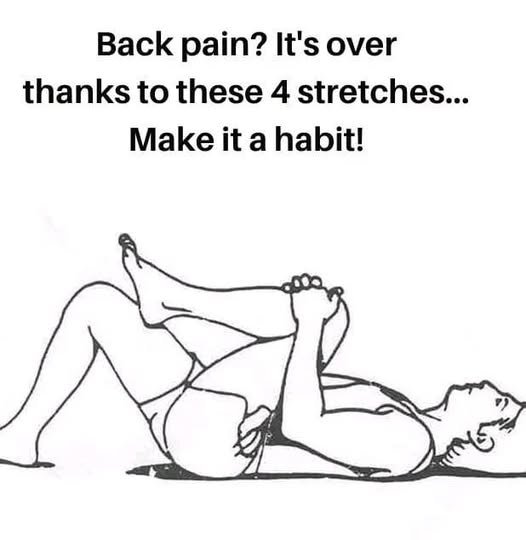
Back Pain? Try These 4 Gentle Stretches to Help You Move More Comfortably
Lie on your back with your knees bent and your feet resting on the floor.
Slowly allow both knees to move toward one side while keeping your upper body relaxed.
Return to the center and repeat on the other side.
Move slowly and stay within a comfortable range.
This exercise is recommended by NHS physiotherapy guidance as one way of gently moving the lower back. (Guy’s and St Thomas’ NHS Trust)
3. Bottom-to-Heels Stretch
Start on your hands and knees with your back in a comfortable position.
Slowly move your hips backward toward your heels while extending your arms forward.
Stop when you feel a gentle stretch.
Return slowly to the starting position.
This movement is another exercise used in physiotherapy guidance for people experiencing lower-back pain. (Guy’s and St Thomas’ NHS Trust)
4. Gentle Back Extension
Lie on your stomach and support yourself on your forearms.
If comfortable, gently lift your chest while allowing your lower back to extend naturally.
Do not force the movement or push through sharp pain.
Some people find extension-based movements comfortable, while others may find them uncomfortable. The best exercise depends on the individual and the cause of their back pain.
How Often Should You Stretch?
There isn’t one perfect routine for everyone.
A good approach is to begin with a small amount of comfortable movement and gradually increase activity as your body allows. Some physiotherapy guidance suggests starting with around 7–10 repetitions and building up gradually, rather than immediately doing a large number of repetitions. (DynamicHealth)
You can also incorporate simple activities such as:
🚶 Walking
🏊 Swimming
🧘 Gentle yoga
🤸 Mobility exercises
🚴 Light physical activity
Regular movement can help prevent stiffness and maintain strength and flexibility. (nhs.uk)
Should You Stretch Through Pain?
No.
A mild stretching sensation can be normal, but sharp, severe, or rapidly worsening pain is a reason to stop.
NHS guidance specifically recommends stopping exercises if they make your pain worse and seeking medical advice when appropriate. (nhs.uk)
If one particular exercise consistently aggravates your symptoms, don’t assume that you simply need to “push through it.”
When Back Pain Needs Medical Attention
Most back pain is not caused by a serious condition, but certain symptoms should not be ignored.
Seek urgent medical attention if back pain is accompanied by symptoms such as new problems controlling your bladder or bowels, numbness around the genitals or anus, or significant weakness or numbness in both legs. These can indicate a potentially serious spinal problem. (nhs.uk)
You should also speak with a healthcare professional if your pain is getting progressively worse, doesn’t improve after a few weeks, significantly interferes with daily activities, or occurs with unexplained weight loss, fever, or other concerning symptoms. (nhs.uk)
A Simple Daily Habit
You don’t need an intense workout to start taking better care of your back.
Try making gentle movement part of your daily routine:
Morning: a few gentle mobility movements During the day: avoid sitting in the same position for too long Evening: gentle stretching or a short walk
The goal isn’t to complete the most difficult stretch. The goal is to keep your body moving consistently and comfortably.
Final Thoughts
The four movements shown in the image can be useful examples of gentle mobility exercises, but they are not a universal cure for back pain.
The right exercises depend on the cause of your symptoms, your mobility, your fitness level, and any other health conditions you may have. For persistent or severe pain, a physiotherapist or healthcare professional can help you choose appropriate exercises. (Guy’s and St Thomas’ NHS Trust)
Start gently, stay consistent, and listen to your body.
💬 What helps your back feel better?
Do you prefer stretching, walking, yoga, or another type of exercise? Share your experience in the comments. 👇
Medical disclaimer: This article is for general educational purposes and does not replace individualized medical advice, diagnosis, or treatment.
To provide the best experiences, we use technologies like cookies to store and/or access device information. Consenting to these technologies will allow us to process data such as browsing behavior or unique IDs on this site. Not consenting or withdrawing consent, may adversely affect certain features and functions.
Functional
Always active
The technical storage or access is strictly necessary for the legitimate purpose of enabling the use of a specific service explicitly requested by the subscriber or user, or for the sole purpose of carrying out the transmission of a communication over an electronic communications network.
Preferences
The technical storage or access is necessary for the legitimate purpose of storing preferences that are not requested by the subscriber or user.
Statistics
The technical storage or access that is used exclusively for statistical purposes.The technical storage or access that is used exclusively for anonymous statistical purposes. Without a subpoena, voluntary compliance on the part of your Internet Service Provider, or additional records from a third party, information stored or retrieved for this purpose alone cannot usually be used to identify you.
Marketing
The technical storage or access is required to create user profiles to send advertising, or to track the user on a website or across several websites for similar marketing purposes.