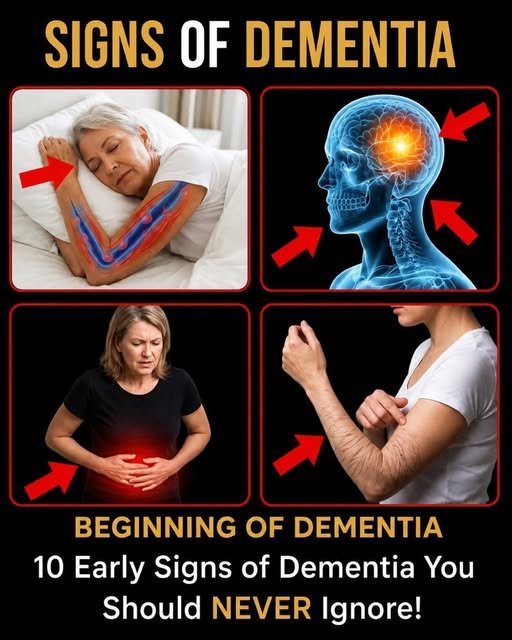
10 Early Signs of Dementia You Should Never Ignore
Dementia is not simply a normal part of getting older. It is a general term for problems with memory, thinking, language, judgment and other abilities that become serious enough to interfere with everyday life. (nhs.uk)
The important thing to remember is that one symptom does not automatically mean dementia. Memory and concentration can also be affected by stress, depression, medications, sleep problems and other medical conditions. A persistent or worsening change deserves a medical evaluation. (nhs.uk)
1. Memory Loss That Affects Daily Life
Occasionally forgetting a name or appointment happens to everyone. A more concerning pattern is repeatedly forgetting recently learned information, important events, or asking the same question over and over.
Forgetting something and remembering it later is different from consistently being unable to recall it.
2. Difficulty Planning or Solving Problems
A person may suddenly struggle with tasks that used to be routine, such as following a familiar recipe, managing household bills, keeping track of appointments or organizing a project.
Another warning sign is difficulty performing familiar activities.
Someone might have trouble driving to a familiar location, operating a familiar appliance, organizing groceries or remembering the rules of a favorite game.
4. Confusion About Time or Place
Occasionally forgetting what day it is isn’t necessarily concerning.
But repeatedly becoming confused about dates, seasons, where you are, or how you arrived somewhere can be a warning sign.
5. Problems With Words or Conversations
A person may struggle to find familiar words, lose track of a conversation, repeat themselves or have difficulty understanding what others are saying.
These language changes can become increasingly noticeable over time. (nhs.uk)
6. Misplacing Things and Being Unable to Retrace Steps
Everyone occasionally loses their keys.
A more concerning pattern is putting objects in unusual places and being unable to retrace your steps to find them. In some cases, a person may even believe someone else has taken the missing item. (Alzheimer’s Association)
7. Poorer Judgment
Changes in decision-making can sometimes appear before more obvious memory problems.
Examples can include unusual financial decisions, becoming more vulnerable to scams, or neglecting personal hygiene and everyday responsibilities.
8. Withdrawal From Hobbies and Social Activities
Someone who previously enjoyed meeting friends, attending activities or pursuing hobbies may gradually withdraw.
This can happen because conversations and activities that were once easy have become more difficult or frustrating. (Alzheimer’s Association)
9. Changes in Mood or Personality
Unexpected changes in personality can include increased anxiety, suspicion, fear, irritability, depression or confusion.
A person may behave noticeably differently from how they normally have throughout their life. (nhs.uk)
10. Difficulty With Visual or Spatial Tasks
Some people develop problems judging distance, reading, recognizing objects, navigating spaces or understanding visual information.
This can sometimes affect activities such as driving or moving around unfamiliar environments. (Alzheimer’s Association)
⚠️ What About the Symptoms Shown in the Image?
The image accompanying this article shows things such as arm discomfort and abdominal discomfort. These are not among the standard 10 early warning signs of dementia listed by the Alzheimer’s Association.
That distinction matters because viral health images sometimes combine unrelated symptoms with a serious diagnosis.
The recognized warning signs focus primarily on changes in memory, thinking, communication, judgment, behavior and the ability to perform familiar activities. (Alzheimer’s Association)
🧠 Dementia Is Not Normal Aging
Getting older can sometimes mean taking longer to remember a name or occasionally forgetting an appointment.
But dementia involves changes that progressively interfere with everyday life. The NHS emphasizes that dementia is not a natural part of aging. (nhs.uk)
The difference is often the frequency, progression and impact on daily activities.
🩺 When Should You Talk to a Doctor?
If you or someone close to you is experiencing several of these changes, particularly if they are new, persistent or getting worse, make an appointment with a healthcare professional.
A doctor can investigate possible causes because memory and thinking problems aren’t always caused by dementia. Some other causes may be treatable. (nhs.uk)
Early assessment can also help clarify what is happening and, when appropriate, provide access to treatment and support sooner. (Alzheimer’s Association)
❤️ The Bottom Line
Don’t panic because you occasionally forget something.
But don’t ignore persistent changes that interfere with everyday life, either.
To provide the best experiences, we use technologies like cookies to store and/or access device information. Consenting to these technologies will allow us to process data such as browsing behavior or unique IDs on this site. Not consenting or withdrawing consent, may adversely affect certain features and functions.
Functional
Always active
The technical storage or access is strictly necessary for the legitimate purpose of enabling the use of a specific service explicitly requested by the subscriber or user, or for the sole purpose of carrying out the transmission of a communication over an electronic communications network.
Preferences
The technical storage or access is necessary for the legitimate purpose of storing preferences that are not requested by the subscriber or user.
Statistics
The technical storage or access that is used exclusively for statistical purposes.The technical storage or access that is used exclusively for anonymous statistical purposes. Without a subpoena, voluntary compliance on the part of your Internet Service Provider, or additional records from a third party, information stored or retrieved for this purpose alone cannot usually be used to identify you.
Marketing
The technical storage or access is required to create user profiles to send advertising, or to track the user on a website or across several websites for similar marketing purposes.