Brain teasers have fascinated people for generations because they challenge the way we think. Sometimes the answer isn’t about complicated math or logic—it’s about paying close attention to the wording.
This popular riddle has been making the rounds on social media, leaving thousands of people debating the correct answer. Before you scroll down, take a moment to think carefully.
The Riddle
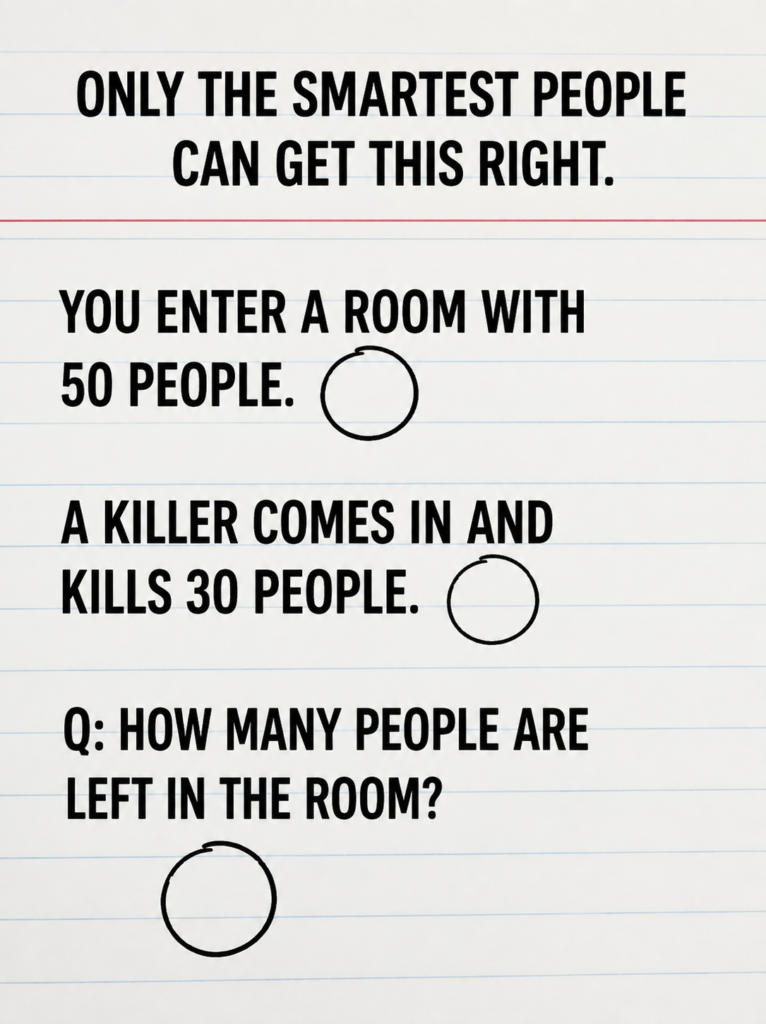
You enter a room with 50 people.
A killer comes in and kills 30 people.
Question:How many people are left in the room?
Take a few seconds to think before reading the explanation.
Common Answers
Many people immediately answer:
20, because 50 − 30 = 20.
Others guess:
21, counting yourself.
However, the wording is a little trickier than that.
The Logical Answer
The question asks:
“How many people are left in the room?”
It does not ask how many people are still alive.
After the killer attacks:
You are still in the room.
The killer is still in the room (unless stated otherwise).
The 30 victims are still physically in the room.
The remaining 20 people may or may not have run away—the riddle doesn’t clearly say.
Because the wording is intentionally ambiguous, different interpretations are possible.
The most common logical answer given is:
32 people (30 victims + you + the killer).
Others argue that 52 people remain if nobody is said to have left.
Why This Riddle Is So Popular
Brain teasers like this work because they encourage us to:
Read carefully.
Avoid making assumptions.
Think beyond simple arithmetic.
Consider different interpretations of the same sentence.
There isn’t always a single universally accepted answer—what matters is how you justify your reasoning.
Tips for Solving Riddles
Read every word carefully.
Don’t assume information that isn’t given.
Consider both literal and logical interpretations.
Think before doing the math.
Final Thoughts
This simple riddle shows how easily our brains jump to conclusions. Whether you answered 20, 32, 52, or another number, the real challenge is paying attention to the wording rather than rushing to the first answer.
What was your answer before reading the explanation? Share it in the comments and see how it compares with everyone else’s! 🧠💬
To provide the best experiences, we use technologies like cookies to store and/or access device information. Consenting to these technologies will allow us to process data such as browsing behavior or unique IDs on this site. Not consenting or withdrawing consent, may adversely affect certain features and functions.
Functional
Always active
The technical storage or access is strictly necessary for the legitimate purpose of enabling the use of a specific service explicitly requested by the subscriber or user, or for the sole purpose of carrying out the transmission of a communication over an electronic communications network.
Preferences
The technical storage or access is necessary for the legitimate purpose of storing preferences that are not requested by the subscriber or user.
Statistics
The technical storage or access that is used exclusively for statistical purposes.The technical storage or access that is used exclusively for anonymous statistical purposes. Without a subpoena, voluntary compliance on the part of your Internet Service Provider, or additional records from a third party, information stored or retrieved for this purpose alone cannot usually be used to identify you.
Marketing
The technical storage or access is required to create user profiles to send advertising, or to track the user on a website or across several websites for similar marketing purposes.