Why Is One Staircase Baluster Upside Down? The Story Behind This Strange Detail
At first glance, an upside-down baluster looks like a simple carpentry m
istake. After all, why would someone spend weeks building a beautiful staircase and then install one spindle in the opposite direction?
Interestingly, there are documented historic examples where an upside-down baluster was intentionally installed. Colonial Williamsburg, for example, describes an upside-down baluster in the King’s Arms Tavern/Alexander Purdie House as an intentional “error” following a colonial custom of placing one baluster “head down.” (Colonial Williamsburg Enseignants)
But the popular explanations surrounding this tradition are a mixture of documented practice and folklore.
🪵 What Is a Baluster?
A baluster is one of the vertical posts supporting a staircase handrail. A group of these posts forms the balustrade.
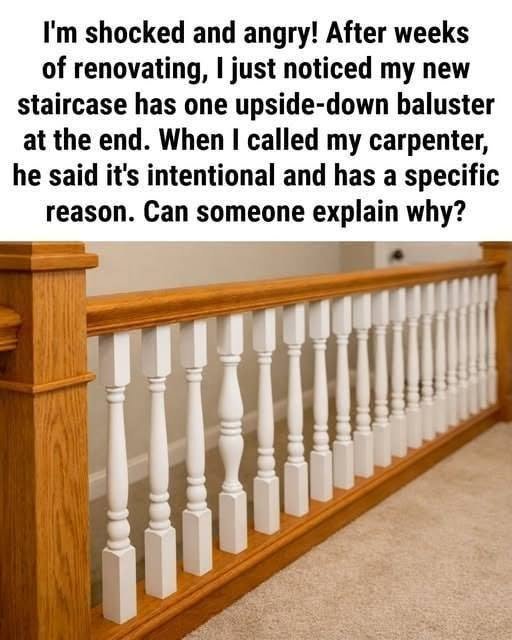
Traditional turned wooden balusters often have decorative shapes that make their orientation obvious. When one is reversed, it immediately stands out from the others.
That’s exactly what makes the detail so interesting.
🙏 The “Only God Is Perfect” Explanation
One of the most popular explanations is that craftsmen deliberately placed one baluster upside down as a reminder that human beings cannot create perfect things.
The idea was essentially:
The staircase may look perfect, but only God is perfect.
This explanation is associated with several historic examples and has become a popular piece of architectural folklore. The South Dakota State Capitol, for instance, has an intentionally inverted baluster on its Grand Staircase. (SDPB)
The Wyoming State Capitol also has an upside-down baluster that has been discussed as an intentional symbolic detail. (Bibliothèque du Wyoming)
😈 Another Old Story: Keeping the Devil Away
There is another, much more mysterious explanation.
According to folklore, an upside-down spindle could supposedly prevent evil spirits—or the devil—from traveling up the staircase.
The idea was that the unusual baluster interrupted the otherwise orderly pattern of the staircase.
This explanation is widely repeated in stories about old houses, although it should be treated as folklore rather than established historical fact. (Newsner English)
🏛️ Was This Really a Tradition?
There is evidence that some historic builders intentionally installed an upside-down baluster, but there doesn’t appear to be one universal explanation for why they did it.
Colonial Williamsburg provides particularly interesting evidence: its historical documentation explicitly describes an upside-down baluster as an intentional error following a colonial custom. (Colonial Williamsburg Enseignants)
That doesn’t prove that every upside-down baluster found in every house has a symbolic meaning.
Some may simply be installation mistakes, replacements, or the result of practical construction decisions.
🛠️ Sometimes It’s Just a Mistake
This is important when looking at modern staircases.
A reversed baluster doesn’t automatically mean that a carpenter was following an ancient tradition.
Modern construction can involve mass-produced spindles, rushed installation, replacement parts, or simple human error. In some cases, an upside-down baluster really may just be upside down.
So if you find one in a newly renovated staircase, don’t immediately assume your carpenter has hidden an ancient secret.
🔎 Why Is the One in the Photo So Noticeable?
The balusters in the photograph have a very consistent decorative pattern.
Most of them have their wider decorative section positioned in the same direction, while one at the end appears reversed.
That’s what makes the difference immediately visible.
Whether this particular staircase was designed with an intentional symbolic “imperfection” or simply had a baluster installed incorrectly cannot be determined from the photograph alone.
🏠 A Small Detail With a Big Story
This is one of those architectural details that makes old houses fascinating.
A tiny wooden spindle can lead to stories about:
Traditional craftsmanship
Religious symbolism
Colonial customs
Superstitions
Human imperfection
Historic building practices
And sometimes, the real answer is simply that someone made a mistake.
Final Thoughts
If you discover one upside-down baluster, don’t automatically assume it was installed incorrectly.
There are genuine historic examples where an inverted baluster was deliberately placed as an intentional imperfection, while other explanations—such as protecting a house from evil spirits—belong more to folklore and tradition. (Colonial Williamsburg Enseignants)
So the next time you walk past an old staircase, take a closer look.
You might discover that one of the spindles isn’t facing the same way as all the others. 👀🪵
Would you leave an upside-down baluster in your home if it had this traditional meaning, or would you immediately fix it? 👇
To provide the best experiences, we use technologies like cookies to store and/or access device information. Consenting to these technologies will allow us to process data such as browsing behavior or unique IDs on this site. Not consenting or withdrawing consent, may adversely affect certain features and functions.
Functional
Always active
The technical storage or access is strictly necessary for the legitimate purpose of enabling the use of a specific service explicitly requested by the subscriber or user, or for the sole purpose of carrying out the transmission of a communication over an electronic communications network.
Preferences
The technical storage or access is necessary for the legitimate purpose of storing preferences that are not requested by the subscriber or user.
Statistics
The technical storage or access that is used exclusively for statistical purposes.The technical storage or access that is used exclusively for anonymous statistical purposes. Without a subpoena, voluntary compliance on the part of your Internet Service Provider, or additional records from a third party, information stored or retrieved for this purpose alone cannot usually be used to identify you.
Marketing
The technical storage or access is required to create user profiles to send advertising, or to track the user on a website or across several websites for similar marketing purposes.